
Whether you're in Indianapolis, Denver, or running multi-site locations across the U.S., 2026 is a decision year for your phones. Carriers are sunsetting copper and many on-prem PBX platforms are end-of-life. Your choice now: stay with a traditional PBX or move to a cloud phone system.
We help organizations like yours weigh the trade-offs, plan migrations, and avoid downtime.
The quick answer
- Cloud phone systems (UCaaS/Hosted VoIP) excel at flexibility, mobility, integrations, and predictable pricing.
- Traditional PBX wins on local control, certain compliance scenarios, and offline survivability with the right design.
- Most teams in 2026 choose cloud for agility and cost, with targeted on-prem gear where it truly adds value.

Cloud vs. PBX in 2026: 7 practical comparisons (with actions)
- Reliability and uptime
- Challenge: You need phones that “just work,” even during ISP hiccups or local outages.
- Compare:
• Cloud: 99.99%+ SLA with multi-region failover; depends on your internet path.
• PBX: Local calling works on-site; survivability depends on PRI/SIP trunks and power/backup. - What to do:
• Implement dual internet or LTE/5G failover for cloud.
• For PBX, add redundant trunks and UPS/generator.
• Ask us about circuit diversity and QoS design. See our hosted voice solutions.
- Cost and budgeting (TCO over 3–5 years)
- Challenge: Avoid surprise expenses and license traps.
- Compare:
• Cloud: OPEX per-user pricing includes upgrades and features.
• PBX: CAPEX upfront plus maintenance, support contracts, and hardware refresh. - What to do:
• Model 36–60 month TCO including handsets, support, and carrier costs.
• Right-size licenses; retire unused DIDs and features.
• Explore our UCaaS IP phone systems for predictable pricing.
- Features and collaboration
- Challenge: Your team needs voice, video, chat, SMS, and contact center that play nicely together.
- Compare:
• Cloud: Rapid feature releases; built-in softphone, video, and integrations.
• PBX: Feature-rich, but add-ons and updates are slower and often cost extra. - What to do:
• Map use cases: frontline, remote, contact center, executives.
• Pilot advanced features (call recording, AI transcription, analytics).
• For SMB productivity, review our office phone systems.
- Mobility and hybrid work
- Challenge: Keep your team reachable on any device, anywhere.
- Compare:
• Cloud: Native mobile/desktop apps, hot desking, seamless handoff.
• PBX: VPNs, SBCs, or third-party clients required for remote users. - What to do:
• Standardize softphones with SSO and MFA.
• Create profiles for BYOD and company-owned devices.
• Document E911 and location services for remote workers.
- Security and compliance
- Challenge: Protect calls, recordings, and identities.
- Compare:
• Cloud: Provider-managed security, end-to-end encryption, regular audits.
• PBX: You control patching, SBCs, firewalls, and SIP trunk security. - What to do:
• Require TLS/SRTP, MFA, and role-based access.
• Define retention for recordings and logs.
• We stay vendor-neutral and align solutions with your policies.
- Scalability and growth
- Challenge: Add locations or users without forklift upgrades.
- Compare:
• Cloud: Instant scaling; add numbers and users on demand.
• PBX: Capacity tied to hardware; expansion may require cards/licensing. - What to do:
• Plan for seasonal staffing and temporary sites.
• Use number inventory hygiene and auto-provisioning.
• Ask us to design multi-site dial plans and call flows.
- Control, customization, and integrations
- Challenge: Match phones to your workflows and apps.
- Compare:
• Cloud: Robust APIs and app marketplaces (CRM, Microsoft 365, ticketing).
• PBX: Deep dial-plan control on-prem; integrations can be custom work. - What to do:
• Document “must-have” automations before choosing vendors.
• Run a proof-of-concept with 2–3 integrations that matter most.
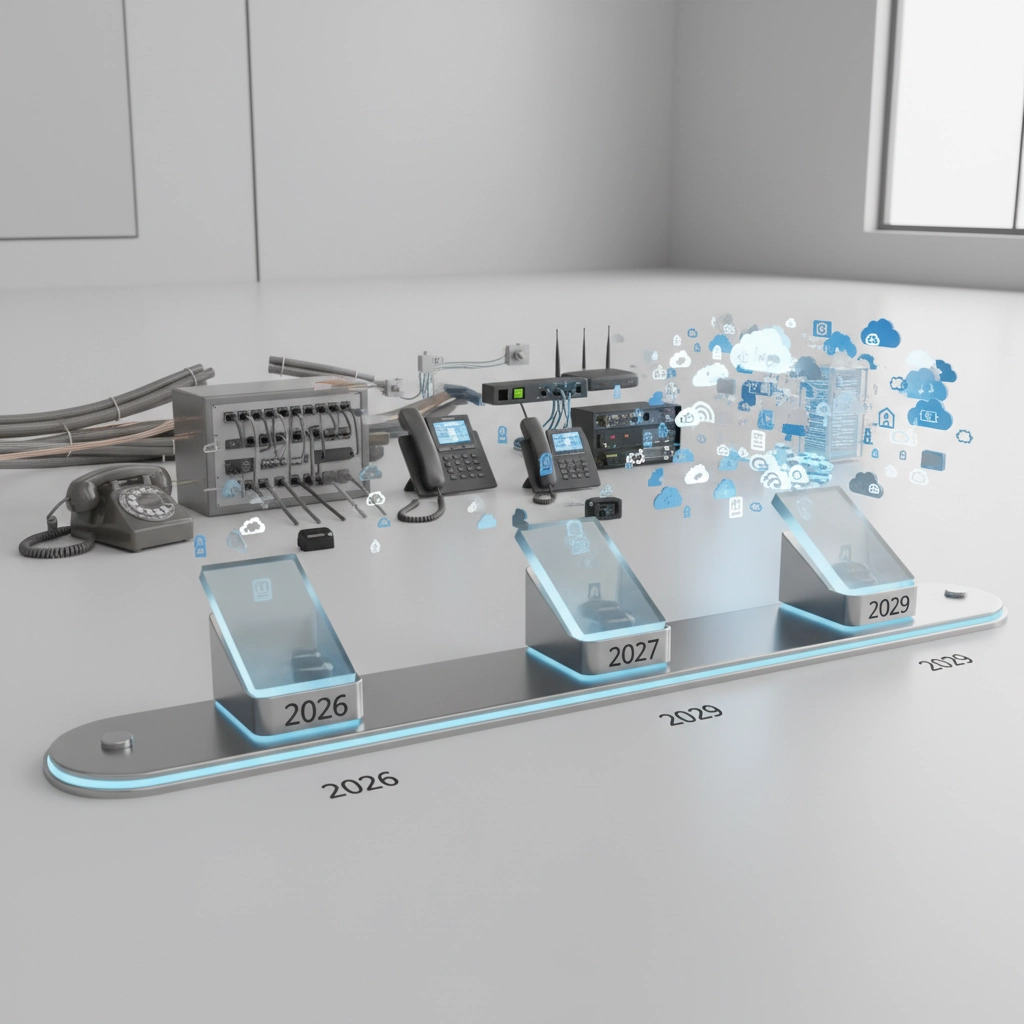
Migration considerations for 2026
-
Network readiness
• Test bandwidth, jitter, latency, and QoS.
• Add SD-WAN or prioritize voice traffic if needed. -
Number porting and cutover
• Validate all DIDs, toll-free, and rollovers.
• Run parallel service for at least one billing cycle. -
E911 and safety
• Configure dynamic location for softphones and remote staff.
• Verify elevator, alarm, and fire panel lines. For copper-dependent devices, see our POTS replacement services. -
Devices and endpoints
• Decide on desk phones vs. headsets/softphones.
• Pre-stage firmware and templates for zero-touch provisioning. -
Training and adoption
• Short, role-based sessions for reception, managers, and agents.
• Quick guides embedded in your intranet or Teams/SharePoint. -
Business continuity
• Enable failover to mobile, voicemail-to-email, and backup auto attendants.
• Document who can trigger emergency routing changes.

Real-world examples
-
Regional restaurant group (30+ locations)
• Problem: Aging PBX with rising support costs and no mobile app.
• Solution: Cloud UCaaS with LTE failover per site and centralized call flows.
• Result: 28% cost reduction and faster onboarding for seasonal staff. -
Community healthcare clinics
• Problem: Mixed PBX sites, HIPAA requirements, and contact center needs.
• Solution: Cloud platform with encrypted call recording and secure messaging.
• Result: Improved patient callbacks and better after-hours routing. -
Construction services firm
• Problem: Field teams unreachable on job sites; PBX not remote-friendly.
• Solution: Softphones with SSO/MFA and device policies; eFax for plans.
• Result: Higher answer rates and fewer missed client calls.

So… which should you choose?
- Choose cloud if you want speed, modern features, remote work, and predictable OPEX.
- Choose PBX (or hybrid) if you require on-prem control, unique compliance, or specialized analog integrations—and you’re prepared to maintain it.
- Many organizations land on cloud-first plus targeted on-prem survivability where it makes sense.
Not sure which path fits your environment? Our vendor-neutral team scopes requirements, brings multiple options, and helps you run a low-risk pilot.
How Premier Business Team helps
-
Assess and plan
• Current-state audit: numbers, call flows, devices, POTS dependencies.
• Network testing and readiness plan. -
Design and vendor selection
• Side-by-side proposals from multiple providers.
• Dial plan, integrations, and redundancy design. See our UCaaS IP phone systems. -
Implement and migrate
• Project management, number porting, and parallel run.
• Role-based training and go-live support. Explore our hosted voice solutions. -
Optimize and support
• Monthly reviews, analytics, and license right-sizing.
• Single point of contact—most services are paid by providers, not by you.

Ready to compare your options?
We’re helping organizations like yours make confident 2026 decisions—without sales pressure and without downtime.
- Get a side-by-side cloud vs. PBX TCO analysis.
- See demo call flows mapped to your use cases.
- Run a 30-day pilot with your real numbers and devices.
Contact our team to start your plan: Premier Business Team. We’ll help you choose the smartest path and execute it smoothly—so your phones are an advantage, not a worry.