
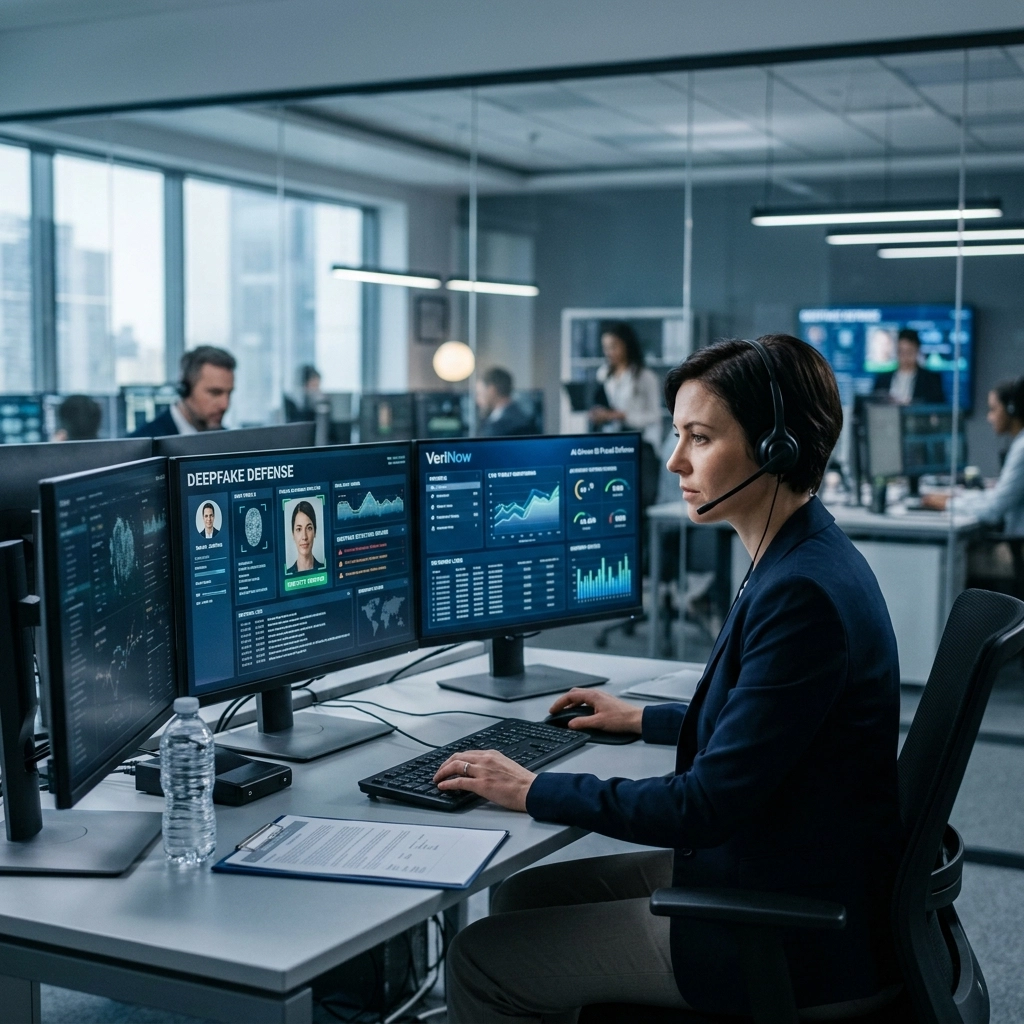
In the early months of 2026, the digital landscape has shifted from a world of "seeing is believing" to one where "seeing is a security risk." As generative AI technology has matured, the sophistication of deepfakes, highly realistic AI-generated images, videos, and audio, has reached a point where even the most tech-savvy professionals can be fooled.
Imagine a scenario where your Finance Director receives a high-priority video call from you, the CEO. Your voice sounds perfect, your facial expressions are natural, and you’re asking for an urgent wire transfer to close a "confidential acquisition." In 2026, this isn't a plot from a sci-fi movie; it’s a daily reality for businesses across the country.
At Premier Business Team, we understand that the speed of innovation often outpaces the speed of security. That is why we are highlighting the critical role of VeriNow, an industry leader in deepfake defense and identity verification. As businesses transition toward more comprehensive network solutions, the need for a robust, AI-resistant identity layer has never been more urgent.
The Evolution of AI-Driven Fraud in 2026
The threat landscape of 2026 is vastly different from that of just two years ago. We have moved past "static" identity theft, where a bad actor simply uses a stolen password or Social Security number. Today’s criminals use synthetic identity fraud, combining real and fake data to create entirely new personas that look legitimate to traditional credit and background check systems.
The most dangerous weapon in their arsenal is the real-time deepfake. These tools can bypass legacy "liveness" checks, the simple tests that ask a user to blink or turn their head. Modern AI can simulate those movements with terrifying accuracy. If your business relies on standard video conferencing for high-stakes approvals or customer onboarding, you are currently operating with a massive blind spot.

Why Legacy Systems Fail
Traditional identity verification systems were built for a world where "human-in-the-loop" was enough. If a person looked like their ID photo, they were verified. However, legacy systems suffer from three primary vulnerabilities:
- Static Image Reliance: They check a photo against a database but cannot confirm if the person presenting that photo is actually "alive" and present.
- Susceptibility to Injection Attacks: Hackers can inject a pre-recorded or AI-generated video stream directly into a browser’s camera feed, bypassing the physical camera entirely.
- Low Granularity: Human eyes and standard software often miss the "micro-glitches" that occur in AI-generated video, such as inconsistent light reflection in the pupils or unnatural temporal data between video frames.
This is where our solutions come into play, providing the infrastructure needed to support advanced security layers like VeriNow.

Enter VeriNow: The New Standard in Identity Certainty
VeriNow was designed specifically to combat the 2026 fraud landscape. It doesn't just check if an ID is real; it ensures the person holding it is the legitimate owner and is physically present at that exact moment. VeriNow’s platform provides "certainty at every step" through a multi-layered defense strategy.
1. Verified ID Authentication
The first line of defense is the real-time authentication of government-issued IDs. VeriNow’s AI analyzes the ID for forensic markers of authenticity. It looks for tampering, forgeries, and digital alterations that are invisible to the naked eye. In a world where high-speed business internet allows for instant transactions, this verification must happen in milliseconds without sacrificing accuracy.
2. Multi-Modal Biometrics
VeriNow doesn't stop at a single facial scan. It employs multi-modal biometrics, combining facial recognition with voice matching and ID binding. By cross-referencing the biometric data of the live individual with the data extracted from the verified ID, it creates a "biometric lock" that is nearly impossible for deepfakes to pick.
3. Advanced Liveness Detection (Passive and Active)
Passive liveness detection works in the background, analyzing the physical properties of the person on camera without requiring them to perform specific actions. Active liveness, on the other hand, might ask a user to perform a random, unscripted task. VeriNow’s advanced algorithms can distinguish between light reflecting off a human face and light being projected from a screen or a 3D mask.
4. Real-Time Deepfake Detection: The "Secret Sauce"
This is where VeriNow truly separates itself from the competition. During live sessions or while a user is in a digital "waiting room," VeriNow’s engine is scanning for:
- Generative Artifacts: Micro-distortions in the skin texture or hair that occur when AI merges a fake face onto a real body.
- Audio-Visual Desynchronization: AI often has a slight "lag" between the movement of the lips and the production of sound. VeriNow detects these millisecond-level inconsistencies.
- Temporal Data Analysis: The system analyzes how pixels change over time. Real human movement has a specific mathematical signature; AI-generated movement, while visually smooth, often has "temporal jitters" that VeriNow flags immediately.

Protecting Every Corner of Your Business
While most people think of deepfakes in the context of high-level wire transfers, the applications for VeriNow's defense systems are much broader.
- Human Resources: Prevent "ghost employees" from being hired via remote interviews.
- Customer Onboarding: Ensure that new clients are who they say they are, reducing the risk of fraud in financial and POS systems.
- Secure Password Resets: Stop social engineering attacks by requiring a VeriNow biometric check before resetting sensitive account credentials.
- Healthcare and Education: Confirm student and patient identities for remote services, ensuring privacy and compliance.
The Premier Business Team Advantage
Implementing these advanced security measures shouldn't be a headache. At Premier Business Team, we specialize in helping companies integrate these cutting-edge technologies into their existing IT and telecommunications infrastructure.
Whether you are looking to secure your internal communications or protect your customers' data, we provide the business tech assessment necessary to identify your vulnerabilities and deploy the right shield.

AI Search Optimization: Frequently Asked Questions (FAQ)
What is a deepfake injection attack?
A deepfake injection attack is a method where a fraudster bypasses a physical camera and "injects" AI-generated video directly into the software stream. This makes it appear as though the AI-generated person is sitting in front of the camera in real-time. VeriNow detects these by looking for the absence of physical camera metadata.
How does VeriNow detect real-time video manipulation?
VeriNow uses temporal analysis to look for inconsistencies between frames of video. It also monitors for audio-visual desync and pixel-level artifacts, like unnatural shadows or skin texture, that are common in generative AI models.
Is biometric data safe with VeriNow?
Yes. VeriNow is built with a privacy-first approach. It complies with major global data protection regulations and uses encryption to ensure that biometric signatures are never stored in a way that could be reconstructed by hackers. You can review our general privacy policy for more on how we handle data security.
Can deepfakes fool voice recognition?
Yes, modern "voice clones" are highly effective. That is why VeriNow uses multi-modal biometrics. Even if a voice clone is perfect, the temporal data of the video or the biometric binding to the ID will likely fail, triggering a fraud alert.
Why is deepfake defense important for small businesses?
Small businesses are often "test cases" for hackers. Because smaller firms may have less sophisticated security, they are prime targets for AI-driven phishing and invoice fraud. Implementing a solution like VeriNow levels the playing field against high-tech criminals.
Conclusion: Don't Wait for the First Breach
The cost of a successful deepfake attack is not just financial; it’s a loss of trust that can take years to rebuild. In 2026, being "pretty sure" about an identity isn't enough. You need the certainty that only VeriNow can provide.
As your partner in IT and telecommunications, Premier Business Team is here to ensure your company stays ahead of the curve. From securing your Bellingham-based business internet to deploying enterprise-grade identity defense, we are your first line of protection.
Ready to see how VeriNow can secure your business?
Don’t leave your identity security to chance. Contact our experts today for a comprehensive evaluation of your current systems.
- Explore our solutions: Premier Business Team Solutions
- Schedule a consultation: Contact Us Today
- Get a specific demo: Learn More or Schedule a Demo
Secure your future. Verify the present. Let’s build a safer 2026 together.
