

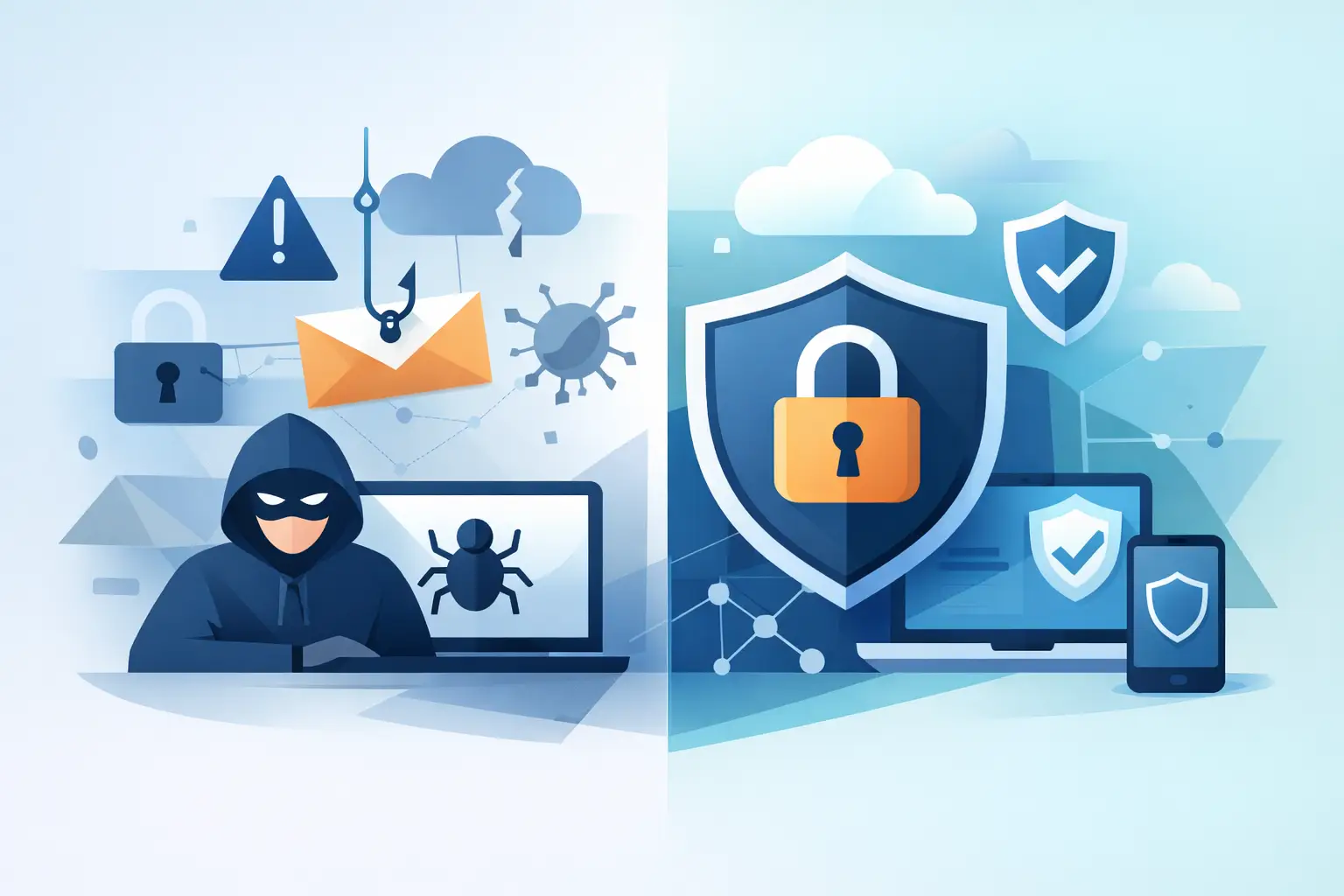
A single phishing email can stall payroll, expose customer data, and force an already busy team into emergency mode by lunchtime. That is why cybersecurity threats and protection are no longer just IT concerns. For small and mid-sized businesses, they are operational, financial, and leadership issues that directly affect uptime, trust, and growth.
Most companies are not dealing with one cleanly defined risk. They are managing a mix of aging systems, expanding cloud environments, remote users, third-party vendors, mobile devices, and limited internal bandwidth. The real challenge is not simply blocking attacks. It is building a practical security posture that fits how the business actually runs.
Why cybersecurity threats and protection matter to business leaders
Cyber risk has moved well beyond the old assumption that attackers only target large enterprises. Smaller organizations are often more attractive because they may have fewer controls, less monitoring, and less time to manage security consistently. Attackers know that a company with 50 to 500 employees can still process payments, store sensitive records, and depend heavily on uninterrupted systems.
The business impact is broader than a single incident response bill. A successful attack can disrupt operations, delay revenue, trigger legal review, damage vendor and customer confidence, and pull leadership attention away from core priorities. Even when cyber insurance helps absorb some of the cost, it does not restore lost time, strained relationships, or missed opportunities.
This is where executive alignment matters. Security decisions affect budgets, workflows, vendor selection, employee policies, and long-term technology planning. Treating protection as a side project usually leads to reactive spending. Treating it as part of business infrastructure leads to better control and fewer surprises.
The most common cybersecurity threats businesses face
Ransomware remains one of the most disruptive risks because it combines downtime, extortion, and recovery complexity in a single event. In many cases, the attacker does not just encrypt files. They also steal data first, which creates additional pressure around disclosure and reputational harm. Recovery depends on more than backups. It depends on clean backups, tested recovery procedures, network segmentation, and fast decision-making.
Phishing and business email compromise continue to cause losses because they exploit people and process gaps rather than technical weaknesses alone. A convincing email asking for a wire transfer, password reset, or invoice update can bypass a lot of expensive tools if the workflow itself is not controlled. These incidents often look ordinary until the money is gone or credentials are reused elsewhere.
Credential theft is another growing problem, especially in businesses that rely on many cloud applications. If employees reuse passwords or if multifactor authentication is inconsistently applied, one stolen login can open the door to email, file storage, CRM data, finance systems, and collaboration tools. The risk increases when user access is not reviewed regularly after role changes or departures.
Third-party and supply chain exposure deserves more attention than it usually gets. Many businesses have strong opinions about their own security but limited visibility into the providers, software platforms, and service partners connected to their environment. If a vendor has weak controls or excessive access, that weakness can become your problem quickly.
Insider risk is more complicated because it is not always malicious. Sometimes an employee sends a file to the wrong recipient, stores data in an unapproved app, or clicks a link while working under pressure. Protection requires more than distrust. It requires policies, training, and systems designed around normal human behavior.
Cybersecurity threats and protection start with risk, not tools
Businesses often ask which security product they should buy first. That is understandable, but the better question is where the business is most exposed. A company with a remote workforce, cloud-first operations, and little internal IT support will not have the same priorities as a manufacturer with on-site systems and connected equipment.
A practical approach starts with identifying critical assets, likely threat paths, and operational consequences. What data would create the most harm if exposed? Which systems would stop revenue-generating activity if they went down? Where are users logging in from, and how is access managed? Which vendors have privileged connections or store sensitive information on your behalf?
Once those answers are clear, protection decisions become more rational. Instead of buying overlapping solutions or reacting to fear-based marketing, leaders can focus on controls that reduce the most meaningful business risk first.
What effective protection looks like in practice
Strong protection is usually layered, but that does not mean complicated for the sake of it. The goal is to make attacks harder to execute, easier to detect, and less damaging if they succeed.
Identity and access management is one of the highest-value areas to strengthen. Multifactor authentication, role-based access, conditional access policies, and regular account reviews can close off a large share of preventable exposure. This is especially true for email, administrative accounts, finance systems, and remote access tools.
Endpoint protection and monitoring are also foundational. Laptops, desktops, mobile devices, and servers need more than basic antivirus. Businesses need visibility into suspicious behavior, a way to isolate compromised devices, and a plan for investigating alerts before they become incidents. The right level of monitoring depends on internal resources. Some organizations can manage this in-house, while others are better served by a managed security model.
Email security, employee awareness, and financial process controls should work together. Training alone is not enough, and filtering alone is not enough either. A stronger model combines threat filtering with practical employee education and approval workflows for payments, vendor changes, and sensitive requests. That mix reduces the odds that one hurried click turns into a major loss.
Backup and disaster recovery are often discussed as if they are separate from cybersecurity. They are not. If backups are incomplete, untested, or accessible from the same compromised environment, recovery becomes far more difficult. Businesses should know how quickly critical systems can be restored, where data is stored, and whether recovery procedures have been validated under realistic conditions.
Network security still matters, but it should match the environment. Some companies need advanced segmentation, secure SD-WAN, and tight traffic controls across locations. Others may need stronger wireless security, better firewall policies, or safer guest network separation. There is no prize for complexity if the business cannot manage it consistently.
The trade-offs leaders should understand
There is no such thing as total security, and trying to eliminate all risk can create unnecessary cost and friction. The better goal is to reduce exposure to a level that fits the business, its compliance needs, and its tolerance for downtime or data loss.
For example, tighter access controls improve protection, but they can also frustrate users if they are poorly implemented. More security tools can increase visibility, but they can also create alert fatigue if nobody owns the response process. Outsourcing security functions can improve coverage and speed, but only if the provider understands your environment and communicates clearly.
That is why vendor-neutral evaluation matters. The right answer is not always the most feature-heavy platform or the cheapest subscription. It is the combination of controls, support model, and implementation approach that aligns with how your business operates.
Building a smarter cybersecurity roadmap
For most organizations, the next step is not a complete overhaul. It is a clear baseline assessment followed by prioritized improvements. Start with visibility. Inventory users, devices, applications, network paths, and key vendors. Review where sensitive data lives and how access is granted. Confirm whether logging, monitoring, and response responsibilities are clearly assigned.
Then address high-impact gaps first. That often means securing identities, strengthening endpoint and email controls, tightening backup and recovery practices, and formalizing incident response. If your team is stretched thin, simplify where possible. Fewer well-managed solutions usually outperform a scattered stack of underused tools.
It also helps to connect security planning to broader technology decisions. Cloud migrations, communications upgrades, network redesigns, and vendor consolidation all affect cyber risk. When those projects are evaluated in isolation, security gaps tend to follow. When they are planned together, companies get better performance and better protection at the same time.
This is where a consultative partner can bring real value. Premier Business Team works with organizations that need objective guidance across infrastructure, cloud, communications, and security, helping leaders compare options and move forward with more confidence and less complexity.
Cybersecurity is not a one-time purchase or a policy document that sits untouched until renewal season. It is an operating discipline. The companies that handle it best are not the ones chasing every headline. They are the ones making steady, informed decisions that protect the business without slowing it down.