


Small businesses are under siege. In 2026, cybercriminals launch attacks on small and medium-sized businesses every 14 seconds, with 60% of targeted companies going out of business within six months of a successful breach.
Here's the harsh reality: hackers don't just target Fortune 500 companies anymore. They've shifted focus to small businesses precisely because they're easier targets with fewer security measures. While large corporations invest millions in cybersecurity infrastructure, small businesses often operate with minimal protection: making them the low-hanging fruit cybercriminals love to exploit.
The good news? Most cyberattacks succeed because of preventable mistakes, not sophisticated hacking techniques. By understanding these common vulnerabilities and implementing straightforward fixes, you can transform your business from an easy target into a hardened fortress that hackers will skip over in favor of easier prey.
1. Using Weak Passwords and Poor Authentication
The Mistake: Your employees are still using passwords like "123456," "password123," or worse: the same password across multiple accounts. Many businesses also rely on default passwords provided by vendors, creating massive security gaps.
Why Hackers Love This: Weak passwords are the equivalent of leaving your front door unlocked with a neon "OPEN" sign. Cybercriminals use automated tools to attempt millions of password combinations per second (brute force attacks) or leverage stolen password databases to access multiple accounts (credential stuffing attacks).

How to Fix It Fast:
- Implement Multi-Factor Authentication (MFA) immediately on all business accounts. Even if hackers crack a password, they'll hit a second security barrier.
- Deploy a business password manager like Bitwarden or 1Password to generate and store unique, complex passwords for every account.
- Establish a formal password policy requiring 12+ character passwords with automatic rotation every 90 days.
- Change ALL default passwords on routers, software, and equipment the moment you receive them.
2. Ignoring Software Updates and Security Patches
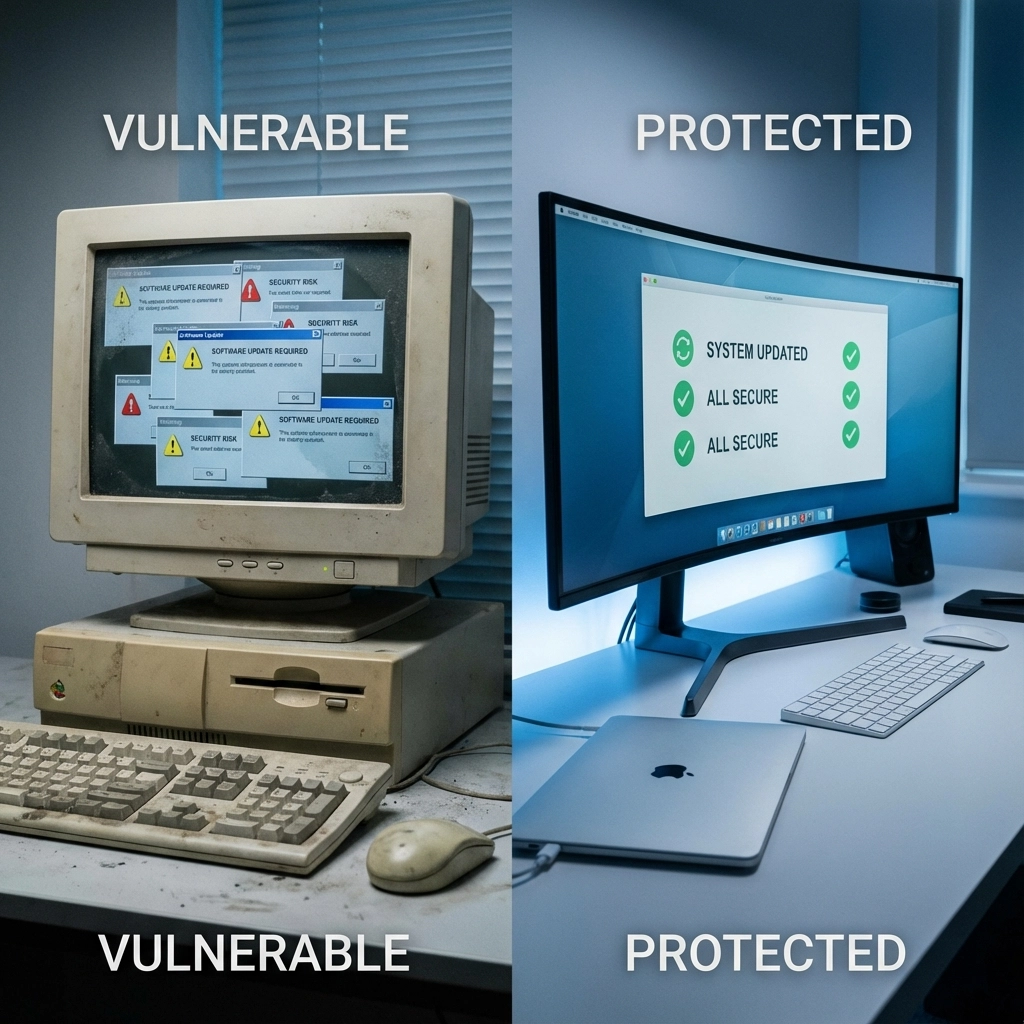
The Mistake: Your team treats software update notifications like annoying pop-ups, constantly clicking "Remind Me Later" or assuming that cyber threats only target larger corporations.
Why Hackers Exploit This: Unpatched software contains known vulnerabilities that hackers actively scan for using automated tools. When Microsoft, Adobe, or other vendors release security patches, they're essentially publishing a roadmap of vulnerabilities. Businesses that don't update quickly become sitting ducks for ransomware and malware attacks.
How to Fix It Fast:
- Enable automatic updates for operating systems, antivirus software, and critical business applications.
- Create a patch management schedule with designated "update windows" to minimize business disruption.
- Retire legacy software that no longer receives vendor security support: these systems are hacker goldmines.
- Never ignore security patches, especially for web browsers, email clients, and network equipment.
3. Operating Without a Data Backup and Recovery Plan
The Mistake: Your business relies on manual backup methods, outdated systems, or worse: no backup strategy at all. Many small businesses assume their data is "safe" because it's stored locally or that disasters "won't happen to us."
Why This Is Catastrophic: When ransomware strikes or hardware fails, businesses without proper backups face an impossible choice: pay criminal ransoms (with no guarantee of data recovery) or permanently lose years of customer data, financial records, and operational information.
How to Fix It Fast:
- Follow the 3-2-1 backup rule: 3 copies of critical data, on 2 different storage types, with 1 copy stored offsite.
- Automate daily backups of all critical business data to cloud storage services.
- Test your backups monthly by actually restoring files to ensure they work when needed.
- Document your recovery procedures so any team member can restore operations during emergencies.
4. Underestimating Your Value as a Target
The Mistake: Small business owners mistakenly believe cybercriminals only target large corporations with massive databases and million-dollar accounts.
Why This Mindset Is Dangerous: This false sense of security leads businesses to skip basic cybersecurity measures, leaving systems wide open to attacks. In reality, small businesses are attractive targets precisely because they're perceived as easier to penetrate and less likely to have incident response teams.
How to Fix It Fast:
- Conduct a realistic threat assessment acknowledging that your business contains valuable data (customer information, financial records, vendor relationships).
- Implement basic security hygiene like secure Wi-Fi networks with WPA3 encryption and guest network separation.
- Limit data access on a need-to-know basis: not every employee needs access to customer payment information.
- Monitor your business credit and bank accounts for unauthorized activity that could signal a breach.
5. Failing to Train Employees on Cybersecurity Basics
The Mistake: Your team lacks cybersecurity awareness and can't recognize phishing emails, suspicious links, or social engineering tactics designed to trick them into revealing sensitive information.
Why Human Error Is Your Biggest Risk: Even with perfect technical defenses, one employee clicking a malicious link or downloading an infected attachment can compromise your entire network. Cybercriminals specifically target human psychology because it's often easier than breaking through technical barriers.

How to Fix It Fast:
- Conduct monthly cybersecurity training covering phishing identification, password security, and social engineering recognition.
- Run simulated phishing tests to identify which employees need additional training without punishing honest mistakes.
- Create clear reporting procedures so employees feel comfortable reporting suspicious emails or potential security incidents.
- Establish a "security-first" culture where questioning unusual requests is encouraged and rewarded.
For comprehensive insights on protecting your business from evolving cyber threats, check out our detailed guide on cybersecurity secrets that IT consultants don't want small businesses to know.
6. Lacking Comprehensive Endpoint Protection
The Mistake: Many small businesses assume basic antivirus software provides adequate protection, overlooking the need for comprehensive endpoint security across all devices: especially with remote work and bring-your-own-device (BYOD) policies.
Why Endpoints Are Hacker Gateways: Every laptop, smartphone, and tablet that connects to your network represents a potential entry point for malware, ransomware, and unauthorized access. Remote workers often connect from unsecured Wi-Fi networks, multiplying these risks exponentially.
How to Fix It Fast:
- Deploy centralized endpoint protection that includes antivirus, anti-malware, firewall management, and device monitoring.
- Require security software installation on all devices (company-owned and personal) before network access.
- Implement device encryption for laptops and mobile devices containing business data.
- Monitor endpoint activity for unusual behavior that could indicate compromise.
7. Operating Without Formal Security Policies and Incident Response Plans
The Mistake: Small businesses fail to document clear security policies for handling sensitive information, vendor relationships, or security incidents, leaving employees to make security decisions based on guesswork.
Why Structure Matters: Without defined frameworks, employees don't know how to securely handle customer data, evaluate vendor security requirements, or respond to potential breaches. This creates inconsistent security practices and delayed incident response.

How to Fix It Fast:
- Document clear security policies covering password management, data handling, incident reporting, remote work protocols, and vendor requirements.
- Create an incident response plan with step-by-step procedures for identifying, containing, and recovering from security incidents.
- Verify vendor security standards before granting network access or sharing sensitive data.
- Schedule annual policy reviews to ensure procedures remain current with evolving threats and business needs.
Understanding how integrated security fits into your overall business infrastructure is crucial. Learn more about how unified communications can integrate your phone, internet, and security systems for comprehensive protection.
Frequently Asked Questions About Small Business Cybersecurity
Q: How often do small businesses get attacked by cybercriminals?
A: Small businesses experience cyberattacks approximately every 14 seconds in 2026, with 43% of all cyberattacks targeting small and medium-sized businesses.
Q: What's the average cost of a cybersecurity breach for small businesses?
A: The average cost ranges from $25,000 to $50,000 per incident, but 60% of small businesses that suffer a major breach go out of business within six months.
Q: Can small businesses afford professional cybersecurity services?
A: Many cybersecurity measures are low-cost or free to implement. Professional managed security services often cost less than recovering from a single successful attack.
Q: How quickly should we patch security vulnerabilities?
A: Critical security patches should be applied within 72 hours of release. High-priority patches should be deployed within one week.
Q: What should we do immediately if we suspect a cybersecurity breach?
A: Immediately disconnect affected systems from your network, preserve evidence, contact your cybersecurity provider or IT consultant, and notify relevant authorities if customer data may be compromised.
Q: Are cloud-based solutions more secure than on-premise systems for small businesses?
A: Cloud providers typically offer enterprise-grade security that small businesses cannot afford to implement independently, making cloud solutions often more secure than on-premise alternatives.
Take Action Today to Protect Your Business
Don't wait for a cybersecurity incident to force your hand. Every day you delay implementing these security measures is another day hackers can exploit these vulnerabilities to damage your business, steal customer data, and destroy your reputation.
At Premier Business Team, we help small and medium-sized businesses in the Pacific Northwest implement comprehensive cybersecurity strategies without breaking the bank. Our experts understand the unique challenges facing growing businesses and can design security solutions that scale with your operations.
Ready to transform your business from an easy target into a secure operation? Contact Premier Business Team today for a complimentary cybersecurity assessment. We'll identify your specific vulnerabilities and create a customized action plan to protect your business, employees, and customers from evolving cyber threats.
Call us now or visit premierbusinessteam.com/ to schedule your free security consultation. Your business's future depends on the decisions you make today.
