

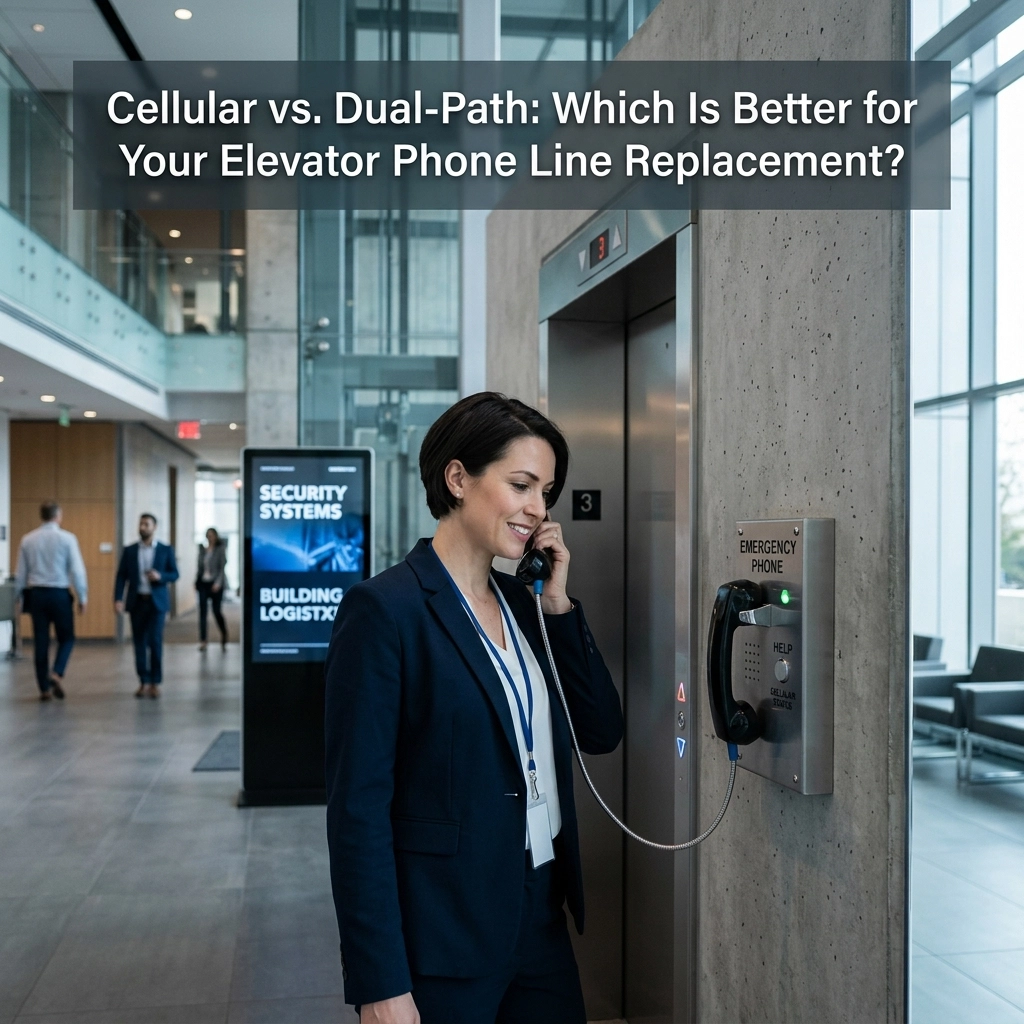
For decades, the "black box" in the corner of the elevator cab relied on a simple, copper-wire connection to the outside world. It was reliable, it was standard, and nobody gave it much thought, until the major carriers began retiring Plain Old Telephone Service (POTS) lines across the country.
Now, property owners and facility managers are facing a critical decision. The sunsetting of copper infrastructure isn't just a technical inconvenience; it’s a life-safety issue. If someone gets stuck in an elevator, that phone line must work. When looking for a replacement, the market generally offers two paths: a standard Cellular Solution or a Dual-Path Solution.
Choosing between them isn't just about price. It’s about understanding the nuances of reliability, safety codes, and long-term infrastructure health. At Premier Business Team, we help businesses navigate these IT and telecommunications solutions every day. Let’s break down which option is the right fit for your building.
Why POTS is No Longer an Option
The shift away from copper is driven by economics and aging technology. Telecom giants are no longer required to maintain the ancient copper networks that have powered elevator phones for a century. As a result, the cost of a single POTS line has skyrocketed in many regions, while the reliability has plummeted. Maintenance crews are harder to find, and parts for central office switches are becoming obsolete.
For property managers, the goal is to move to a digital or wireless alternative that meets strict safety regulations, such as ASME A17.1 and ADA requirements.

Option 1: Standard Cellular Solutions
A standard cellular replacement involves installing a specialized gateway (often referred to as a "cellular bridge" or "LTE gateway") that connects to the existing elevator phone. This gateway converts the analog signal of the elevator phone into a digital signal transmitted over a 4G LTE or 5G network.
The Benefits of Cellular
- Rapid Deployment: One of the biggest perks of cellular is speed. Because you don’t need to pull new wires through a high-rise or across a campus, a technician can often have a system up and running in a matter of hours.
- Cost-Effectiveness: Standard cellular solutions usually offer the lowest monthly recurring cost compared to maintaining an old POTS line.
- Code Compliance: Modern cellular gateways are specifically designed for life-safety applications. They include internal battery backups that keep the line active for several hours during a power outage, meeting most local and national codes.
- Infrastructure Independence: Cellular systems don't rely on your building’s local area network (LAN) or internet service. If your building's primary internet goes down, the elevator phone remains unaffected.
The Considerations
While cellular is highly reliable, it is dependent on signal strength. If your elevator machine room is buried deep in a concrete basement or shielded by heavy steel, you may need an external antenna to ensure a consistent connection.
Option 2: Dual-Path Solutions
Dual-path solutions are the "belt and suspenders" approach to life safety. These systems utilize two independent communication channels, usually a combination of Cellular (LTE/5G) and a secondary path like Ethernet (VoIP/Internet) or even satellite failover.
The Benefits of Dual-Path
- Maximum Resiliency: If one path fails (for example, a cellular tower goes offline or a local internet provider has a fiber cut), the system automatically rolls over to the second path without dropping the call.
- Carrier-Grade Priority: Many dual-path systems are compatible with priority networks like FirstNet. This ensures that during a major emergency where cellular networks might be congested, your life-safety device gets priority access to the airwaves.
- Advanced Monitoring: Dual-path systems often come with more robust cloud-based monitoring. They can "heartbeat" every few minutes to ensure both paths are active, alerting you immediately if one goes down.
- Future-Proofing: By utilizing both the building's internet and a cellular connection, you are insulated against changes in either technology’s landscape.
The Considerations
Dual-path systems generally have a higher upfront hardware cost and a slightly higher monthly subscription fee. They also require more coordination during installation, as the technician will need to interface with your building's IT network. For companies looking to transform their network infrastructure, integrating these systems into a broader strategy is often the smartest move.
Direct Comparison: Cellular vs. Dual-Path
| Feature | Standard Cellular | Dual-Path |
|---|---|---|
| Primary Connection | LTE / 5G | LTE / 5G |
| Secondary Connection | None | Ethernet (VoIP) or Satellite |
| Reliability | High (99.9%) | Extreme (99.99%+) |
| Installation Ease | Very Simple | Moderate (Requires IT Coordination) |
| Compliance | Meets ASME/ADA Standards | Exceeds Standards |
| Monthly Cost | Lower | Moderate |

Safety and Compliance: The Non-Negotiables
Regardless of which path you choose, your replacement must meet specific criteria to keep your building legal and your tenants safe.
- Battery Backup: The system must be able to power the elevator phone for at least 4 to 8 hours (depending on local jurisdiction) during a total building power failure.
- Signal Supervision: The system should be able to notify building management if the connection is lost.
- Voice Quality: The connection must be clear enough for emergency operators to hear the person in the cab. This is why specialized gateways are used instead of generic "off-the-shelf" routers. Some businesses also consider UcaaS and modern IP phone systems for their office staff, but elevator lines remain a specialized niche.
Frequently Asked Questions (FAQ)
Q: Does a cellular elevator phone work in a power outage?
A: Yes, provided it is a code-compliant gateway. Professional installations include a backup battery specifically designed to keep the transceiver alive even when the building loses power.
Q: Can I just use a regular VoIP line for my elevator?
A: Generally, no. Standard VoIP lines often fail to meet the "must-work-during-outage" and "low-latency" requirements for emergency lines. Furthermore, most elevator codes require a dedicated line that doesn't share bandwidth with other building activities.
Q: How do I know if my cellular signal is strong enough?
A: This is where a business tech assessment comes in. A technician can perform a signal site survey to determine if a standard cellular gateway will work or if a dual-path/external antenna setup is necessary.
Q: Is dual-path overkill for a small building?
A: Not necessarily. If your building is in a remote area or an area prone to severe weather, that second path provides peace of mind that can’t be measured in dollars. However, for most low-rise buildings with great cell coverage, standard cellular is often sufficient.
Making the Final Decision
Choosing between cellular and dual-path comes down to a risk-reward calculation.
If you are managing a standard residential or commercial low-to-mid-rise building and are looking for a reliable, code-compliant way to cut the cord on expensive POTS lines, Standard Cellular is likely your best bet. It’s affordable, fast to install, and significantly more reliable than the copper it replaces.
However, if you are managing a high-density facility, a hospital, or a high-rise where tenant safety is the absolute top priority and downtime is not an option, Dual-Path is the gold standard. It provides the redundancy required for the most mission-critical environments.
Why Partner with Premier Business Team?
Navigating the world of telecommunications can be a headache, especially when life-safety codes are involved. At Premier Business Team, we act as your strategic advisor. We don't just sell you a box; we look at your entire infrastructure to ensure your connectivity solutions are robust, compliant, and cost-effective.

Don't wait for your old copper lines to fail or for your next inspection to find a violation. Whether you're looking for Bellingham-specific business phone service or a national rollout of elevator phone replacements, we have the expertise to get it done right.
Ready to upgrade your elevator safety?
Stop overpaying for outdated POTS lines and start protecting your tenants with modern, reliable technology. Contact us today or fill out our lead form to schedule a consultation and find out which solution is best for your property.
