


For multi-location businesses evaluating communication systems in 2026, the ROI question is clear: contact center technologies deliver significantly better long-term returns compared to traditional call centers. While call centers offer lower upfront costs, contact centers provide superior scalability, automation capabilities, and measurable financial returns that justify their higher initial investment, especially as your business grows across multiple locations.
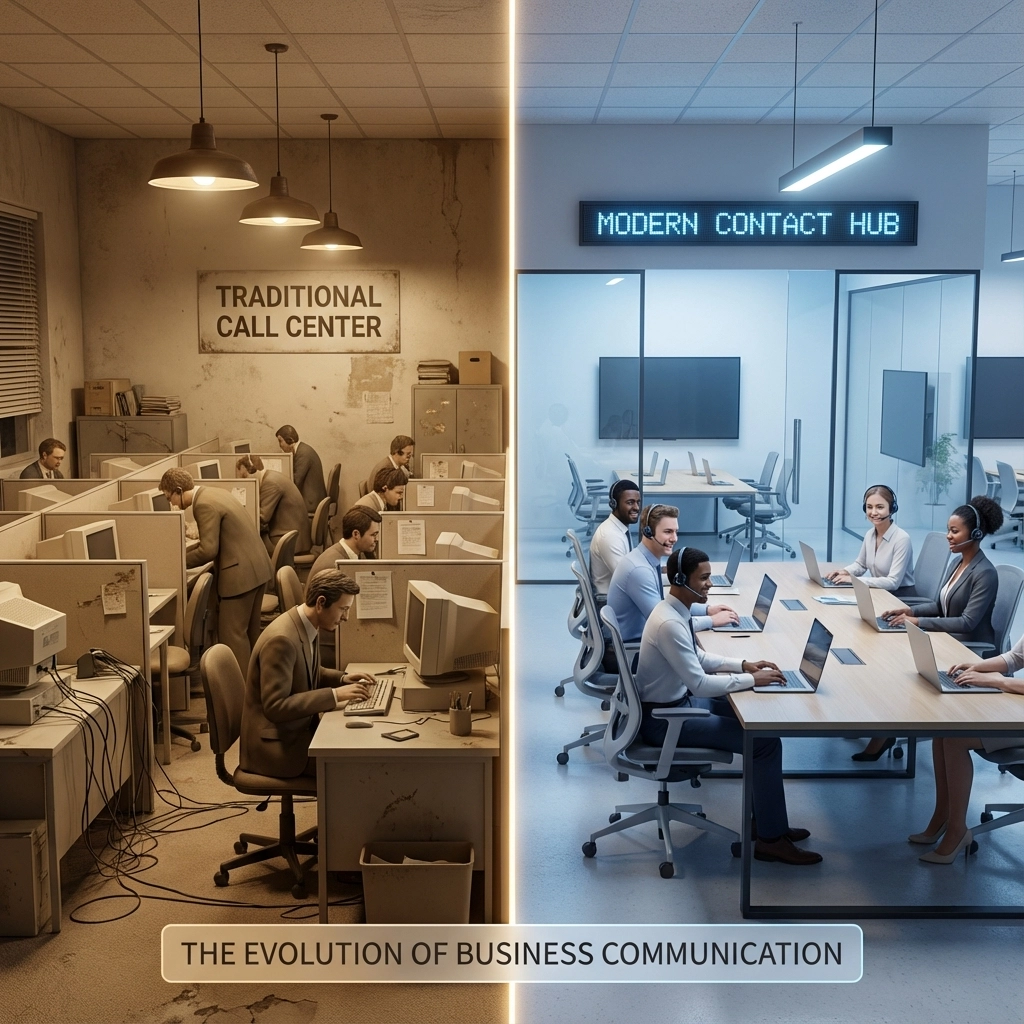
The Traditional Call Center Reality Check
Traditional call centers have served businesses for decades with a straightforward approach: handle phone calls efficiently with minimal technology overhead. For single-location operations with simple customer service needs, they still offer some advantages.
Strengths of Traditional Call Centers
Lower Initial Investment: Call centers require basic phone systems and minimal infrastructure, making them attractive for businesses with tight budgets or simple communication needs.
Operational Simplicity: Fewer moving parts mean easier management with smaller teams. There's no complex software integration or multi-channel coordination required.
Immediate Deployment: Traditional systems can be operational quickly without extensive configuration or training periods.

The Hidden Costs That Add Up
However, traditional call centers face significant limitations that become expensive as businesses scale:
- Physical Infrastructure Dependency: Each new location requires separate hardware, phone lines, and real estate, costs that multiply linearly with growth
- Single-Channel Limitations: Voice-only communication creates bottlenecks and longer wait times, directly impacting customer satisfaction
- High Agent Turnover: Monotonous work environments lead to increased recruitment and training costs
- Limited Scalability: Adding capacity means hiring more agents and expanding physical space
For multi-location businesses, these constraints become deal-breakers as operational complexity and costs spiral upward.
Contact Center Technologies: Built for Multi-Location Success
Modern contact center technologies operate on cloud-based platforms designed specifically for scalability and efficiency. They represent a fundamental shift from reactive call handling to proactive customer engagement across multiple channels.
Core Advantages for Growing Businesses
Cloud-Based Scalability: Deploy new locations without additional hardware investments. Your entire communication infrastructure scales through software, not physical expansion.
Omnichannel Integration: Handle customer interactions across phone, email, chat, SMS, social media, and video from a unified platform. This flexibility directly impacts revenue, 48% of customers switch brands for better service experiences.
Advanced Automation: AI chatbots, intelligent routing, and automated workflows reduce average handle times by 34+ seconds per interaction. For high-volume operations, every second saved translates to approximately $1 million in annual savings.
Unified Customer Data: Customer interaction history and preferences remain accessible across all locations, enabling consistent, personalized service experiences.

Measurable ROI Impact
Contact centers deliver concrete financial benefits that traditional call centers simply cannot match:
- First Call Resolution: Optimized contact centers achieve 85%+ resolution rates compared to 60-70% for traditional systems
- Cost Reduction: Businesses report up to 30% savings in customer service costs through automation and efficiency improvements
- Annual Savings: Documented cases show $2.5+ million in annual savings through improved performance metrics
- IVR Containment: Advanced systems handle nearly 65% of routine inquiries automatically, freeing agents for complex interactions
ROI Comparison: The Numbers That Matter
| Metric | Traditional Call Centers | Contact Center Technologies |
|---|---|---|
| Initial Setup Cost | Lower ($50K-$100K) | Higher ($100K-$300K) |
| Cost Per New Location | High (full infrastructure) | Minimal (software licensing) |
| Average Handle Time | 6-8 minutes | 4-5 minutes (34+ second reduction) |
| First Call Resolution | 60-70% | 85%+ |
| Agent Utilization | 60-70% | 80-90% |
| Customer Satisfaction | 3.2-3.8/5 | 4.2-4.7/5 |
| Annual Operating Cost | Increases linearly | Economies of scale improve efficiency |
| Payback Period | N/A (maintenance mode) | 12-24 months |

Strategic Recommendations by Business Type
Choose Contact Center Technologies If:
- Multi-location operations: Unified platforms eliminate per-location infrastructure costs
- Growth-focused businesses: Cloud scalability supports expansion without capital investment
- Customer-first brands: Omnichannel support drives satisfaction and retention
- High-volume interactions: Automation ROI becomes significant with scale
Contact centers are particularly valuable for businesses in retail, healthcare, financial services, and any industry where customer experience directly impacts revenue. Companies like retail franchises have achieved unified technology implementations that reduce downtime while improving customer service across all locations.
Consider Traditional Call Centers Only If:
- Single location with no growth plans: Limited scalability requirements
- Severe budget constraints: Immediate cost savings outweigh long-term efficiency
- Simple voice-only needs: Customers primarily prefer phone communication
- Very small operation: Fewer than 10 agents with straightforward interactions
Even in these scenarios, cloud-based contact center solutions often provide better value through lower ongoing maintenance costs and built-in redundancy.
Implementation Strategy for Maximum ROI
Phase 1: Assessment and Planning (Months 1-2)
- Audit current communication costs across all locations
- Identify integration requirements with existing business systems
- Calculate projected ROI based on current call volume and resolution metrics
Phase 2: Pilot Deployment (Months 3-4)
- Implement contact center technology at one location
- Train agents on omnichannel capabilities
- Measure performance improvements and cost savings
Phase 3: Multi-Location Rollout (Months 5-8)
- Deploy unified platform across all locations simultaneously
- Establish centralized reporting and management
- Optimize automation rules based on pilot data
Phase 4: Continuous Optimization (Ongoing)
- Monitor ROI metrics monthly
- Expand automation capabilities as call patterns emerge
- Scale capacity up or down based on seasonal demands
Frequently Asked Questions
Q: How long does it take to see ROI from contact center technology?
A: Most multi-location businesses see positive ROI within 12-24 months through reduced operational costs and improved efficiency metrics.
Q: Can contact centers integrate with our existing business systems?
A: Yes, modern contact centers offer extensive integration capabilities with CRM systems, help desk software, and business applications through APIs and pre-built connectors.
Q: What happens if internet connectivity fails at one location?
A: Cloud-based contact centers include automatic failover routing, ensuring calls are redirected to other locations or mobile agents without service interruption.
Q: How do contact centers handle peak seasonal demands?
A: Cloud platforms allow rapid scaling of agent capacity without hardware investment. You can add temporary agents or expand automated handling during high-volume periods.
Q: Are there ongoing training requirements for staff?
A: Initial training typically takes 1-2 weeks, with ongoing education as new features are added. However, intuitive interfaces reduce learning curves compared to traditional systems.
The Bottom Line: ROI Favors Contact Center Technology
For multi-location businesses in 2026, contact center technologies deliver superior ROI through measurable cost savings, improved customer satisfaction, and operational scalability that traditional call centers cannot match. While the initial investment is higher, the long-term financial benefits: combined with competitive advantages in customer experience: make contact centers the clear choice for growing businesses.
The question isn't whether you can afford to upgrade to contact center technology; it's whether you can afford not to. As customer expectations continue rising and communication channels multiply, businesses stuck with traditional call centers will find themselves at an increasing competitive disadvantage.
Ready to calculate your specific ROI and explore contact center solutions for your multi-location business? Contact Premier Business Team today for a free assessment of your current communication costs and a customized projection of potential savings. Our technology experts will help you design a scalable solution that grows with your business while delivering measurable returns from day one.
