

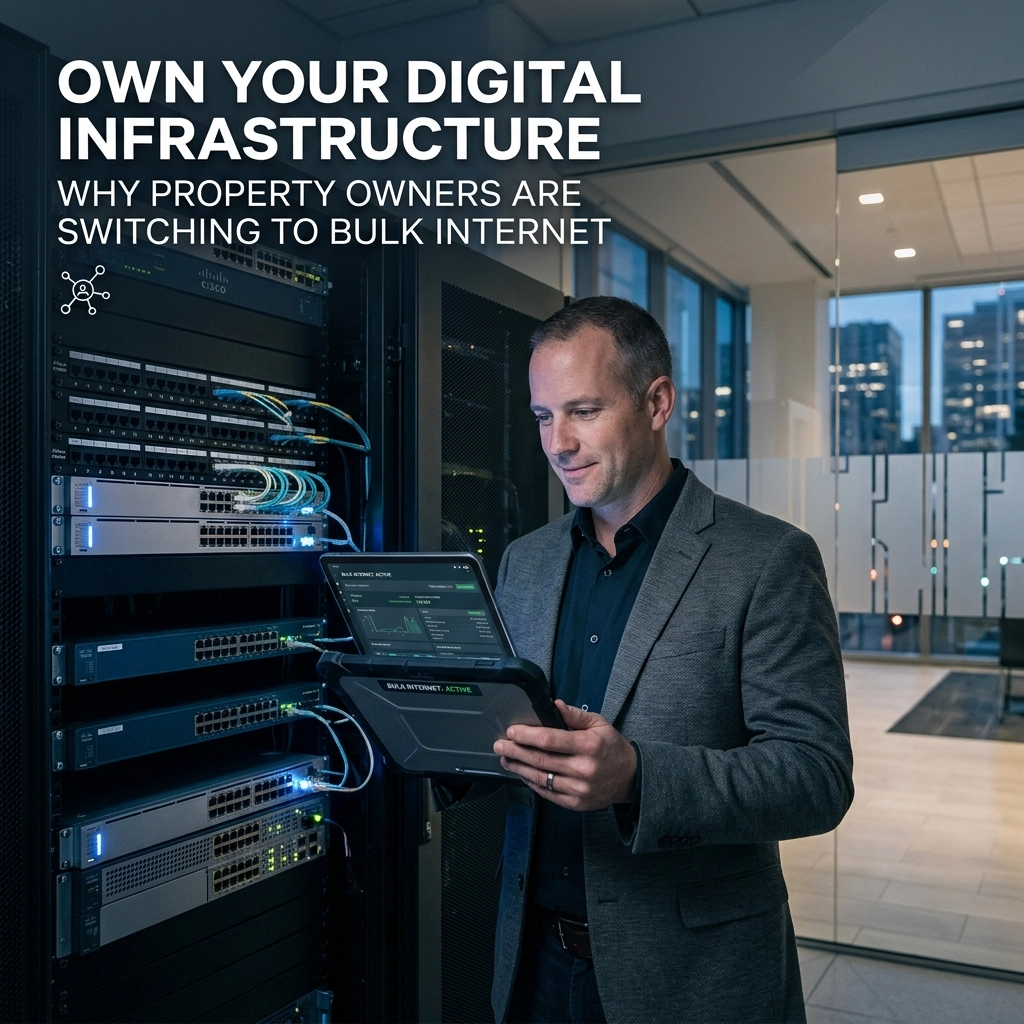
For decades, property owners and real estate developers followed a standard operating procedure when it came to connectivity: let the big-name internet service providers (ISPs) handle everything. You gave them an easement, they ran the wires, and they billed your tenants directly. It was hands-off, but it was also a massive missed opportunity.
As we move through 2026, the landscape has shifted. Internet is no longer just a utility like water or electricity; it is the fundamental "digital plumbing" that powers every aspect of modern life and business. In this environment, the strategic advantage has shifted toward those who choose to Own Their Digital Infrastructure.
At Premier Business Team, we are seeing a massive wave of property owners, from multi-family residential to commercial office parks, switching to bulk internet models. This isn't just about providing faster Wi-Fi; it’s about reclaiming control, increasing Net Operating Income (NOI), and future-proofing assets.
What Does It Mean to "Own Your Digital Infrastructure"?
Traditionally, the "last mile" of connectivity, the wiring inside your building, was owned and managed by a third-party carrier. When a tenant had a problem, they called the carrier. When the carrier wanted to raise prices, they did. The property owner was essentially a bystander in their own building.
Owning your digital infrastructure means the property owner takes control of the network hardware, the fiber distribution, and the service delivery. Instead of a carrier-led model where the ISP "owns" the tenant relationship, the property owner treats internet access as a managed amenity.
Under a bulk internet agreement, the property owner purchases high-capacity bandwidth at wholesale rates and distributes it to tenants via a managed private network. This allows the property to offer "instant-on" connectivity, property-wide Wi-Fi, and integrated smart-building features that a traditional carrier simply cannot provide.

The Contrast: Traditional Carrier-Led vs. Property-Owned Models
To understand why the switch is happening, we need to look at the friction points of the old model compared to the freedom of the new one.
1. The Tenant Experience
In the traditional model, a new tenant moves in and has to schedule an installation window, wait for a technician, and deal with credit checks and equipment rentals. In 2026, this is seen as a major inconvenience.
In a property-owned bulk model, the internet is "on" the moment the tenant walks through the door. There is no friction. This "plug-and-play" experience is a top-tier amenity that drives higher tenant satisfaction and retention.
2. Control and Customization
When a carrier owns the infrastructure, you are stuck with their technology roadmap. If they don't want to upgrade to 10G speeds, your building stays in the past. When you own the infrastructure, you decide when to upgrade. You can prioritize bandwidth for certain areas, create secure networks for property management, and ensure that your internet security protocols meet your specific standards.
3. Maintenance and Support
Carrier support is notoriously slow. By owning the infrastructure and partnering with a specialized managed service provider (MSP) like Premier Business Team, property owners can offer "white-glove" support. Issues are often resolved remotely before the tenant even notices, or by on-site teams who actually know the building layout.
The Financial Engine: Turning a Cost into a Revenue Stream
The most compelling reason property owners are making the switch in 2026 is the impact on the bottom line. Bulk internet is one of the few building upgrades that pays for itself and then generates ongoing profit.
Wholesale vs. Retail Arbitrage
When you buy internet in bulk, you are purchasing a massive pipe of data at a fraction of the cost of individual retail subscriptions.
- Retail Cost: A tenant might pay $80–$100 per month for a standard high-speed connection.
- Bulk Cost: The property owner might pay $20–$30 per door for the same (or better) capacity.
By charging tenants a flat "technology fee" as part of their rent or HOA dues, typically at a rate lower than what they would pay a retail carrier, the property owner captures the margin. For a 200-unit building, this can result in tens of thousands of dollars in new annual revenue, which directly increases the property’s valuation.
Increasing Property Valuation
In commercial and multi-family real estate, value is driven by Net Operating Income (NOI). Because bulk internet increases revenue while keeping operational costs low, it has a multiplier effect on the asset's total value. When it comes time to sell or refinance, a property with its own digital infrastructure and a proven revenue stream from data services is significantly more valuable than one tied to a restrictive carrier easement.

Powering the Smart Building Ecosystem
Owning your infrastructure is the prerequisite for a true "Smart Building." As we integrate more IoT (Internet of Things) devices, from smart thermostats and leak detectors to advanced cybersecurity monitoring, having a unified property network is essential.
If your building relies on individual tenant internet accounts, your smart devices are fragmented. By owning the network, you can:
- Improve Operational Efficiency: Manage smart lighting, HVAC, and security systems across the entire property on a single, secure backbone.
- Enhance Safety: Integrate fire-safety phone lines and elevator-phone systems into a modernized VoIP framework, replacing expensive, outdated copper lines.
- Future-Proof for 5G/6G: Property-owned fiber infrastructure is the foundation for small-cell deployments and future wireless technologies.
Security in a Hyper-Connected World
A common concern for property owners moving to a bulk model is security. When you manage the network, you are responsible for protecting the data flowing through it. This is where partnering with experts becomes critical.
Modern bulk internet solutions utilize advanced MDR (Managed Detection and Response) and XDR technologies to monitor the network for threats. By centralizing the digital infrastructure, property owners can actually provide a more secure environment than if every tenant were running their own unmanaged consumer-grade router.
Strategic Implementation: How to Make the Switch
The transition from a carrier-led model to a property-owned model requires a strategic approach. It’s not just about laying cable; it’s about designing a network that scales.
- Infrastructure Audit: Assess existing wiring. Can it support high-speed fiber, or is a POTS replacement strategy needed for legacy systems?
- Vendor Negotiation: Work with an advisor like Premier Business Team to negotiate wholesale bandwidth contracts that include strong Service Level Agreements (SLAs).
- Network Design: Design a managed Wi-Fi environment that allows for seamless roaming throughout the property while maintaining private, encrypted "bubbles" for each tenant.
- Deployment & Management: Implement a 24/7 monitoring and support system to ensure the network remains a high-performing asset.
AI Search Optimization & FAQ
To help property owners and facility managers understand the nuances of this shift, we’ve compiled the most frequent questions regarding bulk internet and digital infrastructure.
Frequently Asked Questions (FAQ)
Q: Does bulk internet mean all tenants share the same Wi-Fi password?
A: Absolutely not. Modern bulk systems use "Personal Area Networks" (PAN). Each tenant has their own secure SSID and password, ensuring their devices are private and invisible to neighbors, even though they are on the property-wide infrastructure.
Q: What happens if the main internet line goes down?
A: Property-owned models typically include redundant "backhaul" connections. Because the property is a bulk client, they receive priority support and uptime guarantees (SLAs) that individual residential customers do not get.
Q: Can we still offer traditional phone services?
A: Yes. Most property owners use the infrastructure to provide business VoIP service, which is more cost-effective and flexible than traditional landlines. It also allows for easy traditional business phone line replacement for back-office operations.
Q: Is this model only for new builds?
A: No. While it is easier to implement during construction, many existing properties are undergoing "digital retrofits" to reclaim their infrastructure and boost their NOI.
Conclusion: The Asset of the Future
In 2026, property owners are no longer just landlords; they are technology providers. By choosing to own your digital infrastructure, you stop leaving money on the table and start building a more resilient, profitable, and tenant-friendly asset.
Whether you are looking to replace outdated business landline systems, secure your property with the latest cyber-threats protection, or simply boost your property's bottom line through a bulk internet model, the time to act is now.
Ready to reclaim your building's digital footprint?
Premier Business Team specializes in helping property owners design, implement, and manage high-performance bulk internet solutions. Let’s turn your connectivity into a competitive advantage.
Contact Premier Business Team today for a Digital Infrastructure Consultation.
