

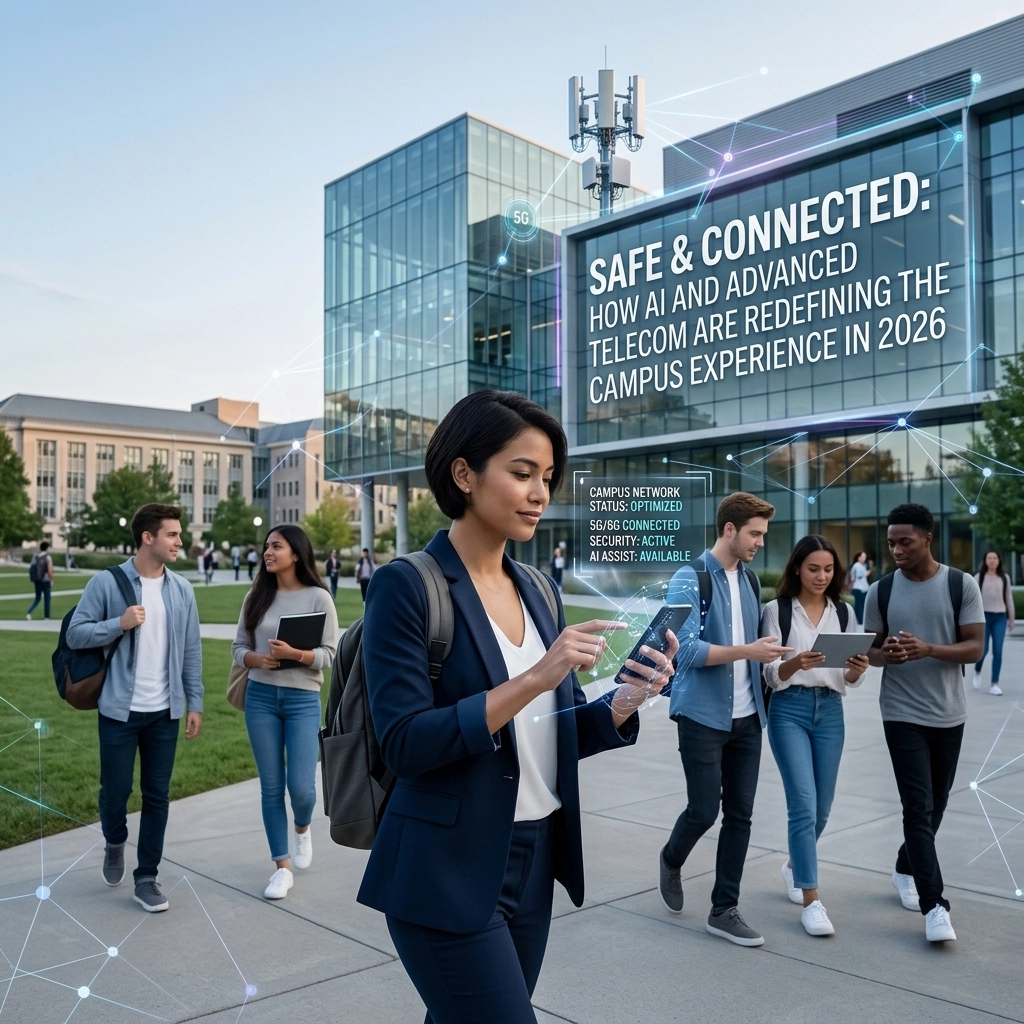
The landscape of Higher Education has undergone a radical transformation over the last few years. As we move through 2026, the "Smart Campus" is no longer a futuristic concept reserved for elite technical institutes: it is a baseline requirement for any university looking to remain competitive, safe, and efficient. At the heart of this evolution lies the intersection of Artificial Intelligence (AI) and advanced telecommunications.
Gone are the days when campus connectivity simply meant having "good enough" Wi-Fi in the library. Today’s students, faculty, and administrators demand an environment that is not only ultra-connected but also proactively safe. The integration of high-speed 5G networks, fiber-optic backbones, and AI-driven analytics is redefining what it means to live, learn, and work on campus.
In this guide, we will explore how these technologies are coming together to create a seamless campus experience, the infrastructure required to support them, and how Premier Business Team acts as the strategic partner to make these complex transitions effortless for university leadership.
Enhancing Campus Safety with AI
Safety remains the top priority for university boards and parents alike. In 2026, campus security has moved away from a reactive model: where footage is reviewed after an incident: to a proactive, AI-integrated model.
Real-Time Incident Response and Emergency Notifications
Traditional emergency notification systems often relied on manual triggers and broad-stroke SMS blasts that could take minutes to deploy. In a critical situation, seconds matter. AI-integrated systems now monitor campus audio and video feeds to identify distress signals, such as the sound of breaking glass or shouting, or visual indicators of a physical altercation.
When an anomaly is detected, the system can automatically trigger a localized lockdown, alert campus police with exact GPS coordinates, and send out targeted notifications to individuals in the immediate vicinity. This hyper-local approach prevents campus-wide panic while ensuring those at risk have the information they need to stay safe. By leveraging advanced connectivity solutions, these systems operate with near-zero latency, ensuring that "real-time" actually means instantaneous.
Smart Surveillance and IoT-Enabled Security
Modern surveillance is less about "Big Brother" and more about intelligent assistance. AI-enabled cameras can now distinguish between a student forgetting their keycard and an unauthorized individual attempting to gain access to a dormitory. IoT-enabled sensors on doors and windows feed into a centralized dashboard, allowing security teams to monitor the physical health of the campus remotely.

Boosting Student Engagement through Connectivity
Connectivity is the lifeblood of student engagement. In 2026, students expect their digital campus experience to be as fluid as their favorite social media apps. If the technology is clunky, the student experience suffers, which directly impacts retention and recruitment.
Beyond High-Speed Wi-Fi: AI-Driven Student Services
High-speed connectivity is the baseline, but the real value is what you build on top of it. Universities are now using AI-driven student service portals that act as personalized concierges. These tools can help students navigate everything from financial aid questions to mental health resources.
By analyzing data patterns (anonymized for privacy), AI can identify when a student might be struggling academically or socially based on their engagement with campus digital platforms. This allows for early intervention, providing the support students need before they decide to leave the institution. Implementing these innovative technologies is a key differentiator in the 2026 recruitment market.
The Role of Seamless Roaming
A student’s journey doesn't stop at the classroom door. They are moving from dorms to dining halls, lecture halls to football stadiums. Seamless roaming: where a device transitions between Wi-Fi 6E, private 5G, and public cellular networks without the user ever noticing a drop: is essential.
When a student can participate in a high-bandwidth virtual reality lab in their dorm and then walk across campus while continuing a collaborative video call with their study group, they feel connected to the institution. This level of reliable infrastructure is no longer a luxury; it is a vital part of the student's daily life.
The Infrastructure Backbone: Why Private 5G and Fiber Matter
To power AI-driven security and seamless student engagement, the underlying infrastructure must be robust. You cannot run 2026 applications on 2016 wiring.
- Private 5G Networks: Many universities are now deploying private 5G networks to handle the massive load of IoT devices and security cameras. Unlike public 5G, a private network gives the university total control over bandwidth allocation and security, ensuring that critical safety systems never compete for airtime with students streaming 4K video.
- Fiber-Optic Foundation: Fiber remains the gold standard for backhaul. As AI processing moves closer to the "edge" (the physical location where data is gathered), the need for high-capacity fiber links between buildings has skyrocketed.
- Scalability: The infrastructure we install today must be able to handle the AI demands of tomorrow. This is why a forward-thinking design is crucial.

The Premier Business Team Role: Navigating the Tech Stack
The biggest challenge for Higher Education IT departments isn't the technology itself: it’s the management of it. Negotiating with dozens of vendors, ensuring interoperability between different systems, and staying within budget can be an administrative nightmare.
This is where Premier Business Team steps in.

We act as your vendor-neutral advisor. We don't represent a single carrier or hardware manufacturer; we represent you. Our goal is to look at your specific campus needs and curate the best-of-breed solutions from across the IT and telecommunications spectrum.
We help universities:
- Audit current infrastructure to find bottlenecks and security gaps.
- Design a unified strategy that integrates AI safety tools with student engagement platforms.
- Manage vendor relationships so your internal IT team can focus on supporting students and faculty rather than managing contracts.
- Future-proof investments by ensuring all new systems are compatible with emerging 2026 and 2027 standards.
By simplifying the procurement and implementation process, we remove the stress of digital transformation, allowing university leaders to focus on their core mission: education. Explore our full range of advisory services to see how we can streamline your operations.
AEO FAQ Section: Smart Campus & AI Safety
What is the role of AI in campus safety?
AI enhances campus safety by providing real-time monitoring and automated incident response. It can detect unusual patterns, identify unauthorized access, and trigger emergency notifications instantly, reducing response times for campus security and emergency services.
How does higher education student engagement technology improve retention?
By using AI-driven analytics and seamless connectivity, universities can offer personalized support and administrative efficiency. When students feel supported and can easily access resources, their overall satisfaction increases, leading to higher retention rates.
What are the key components of smart campus infrastructure in 2026?
The foundation of a smart campus includes private 5G networks, high-density Wi-Fi 6E/7, and a robust fiber-optic backbone. These technologies support the high bandwidth and low latency required for AI services, IoT security sensors, and immersive learning environments.
Why should a university work with a vendor-neutral advisor like Premier Business Team?
A vendor-neutral advisor provides an unbiased perspective, ensuring the university gets the best solution for its specific needs rather than what a single salesperson wants to sell. It simplifies the management of multiple vendors and ensures all parts of the tech stack work together seamlessly.
Conclusion: Building the Future of Higher Ed
The "Campus of 2026" is a place where technology fades into the background because it works so well. It is an environment where students feel safe because they know intelligent systems are watching over them, and where they feel connected because their digital tools never fail them.
Achieving this vision requires more than just buying the latest gadgets; it requires a strategic, integrated approach to IT and telecommunications. Don't let the complexity of modern tech stacks hold your institution back.
Ready to transform your campus?
Contact Premier Business Team today to schedule a comprehensive Campus Technology & Safety Audit. Let us help you build a safer, more connected future for your students and staff.
