


![[HERO] Stop Paying the](https://cdn.marblism.com/YWNmuwYZ0gm.webp)
Your IT budget is bleeding from a thousand tiny cuts.
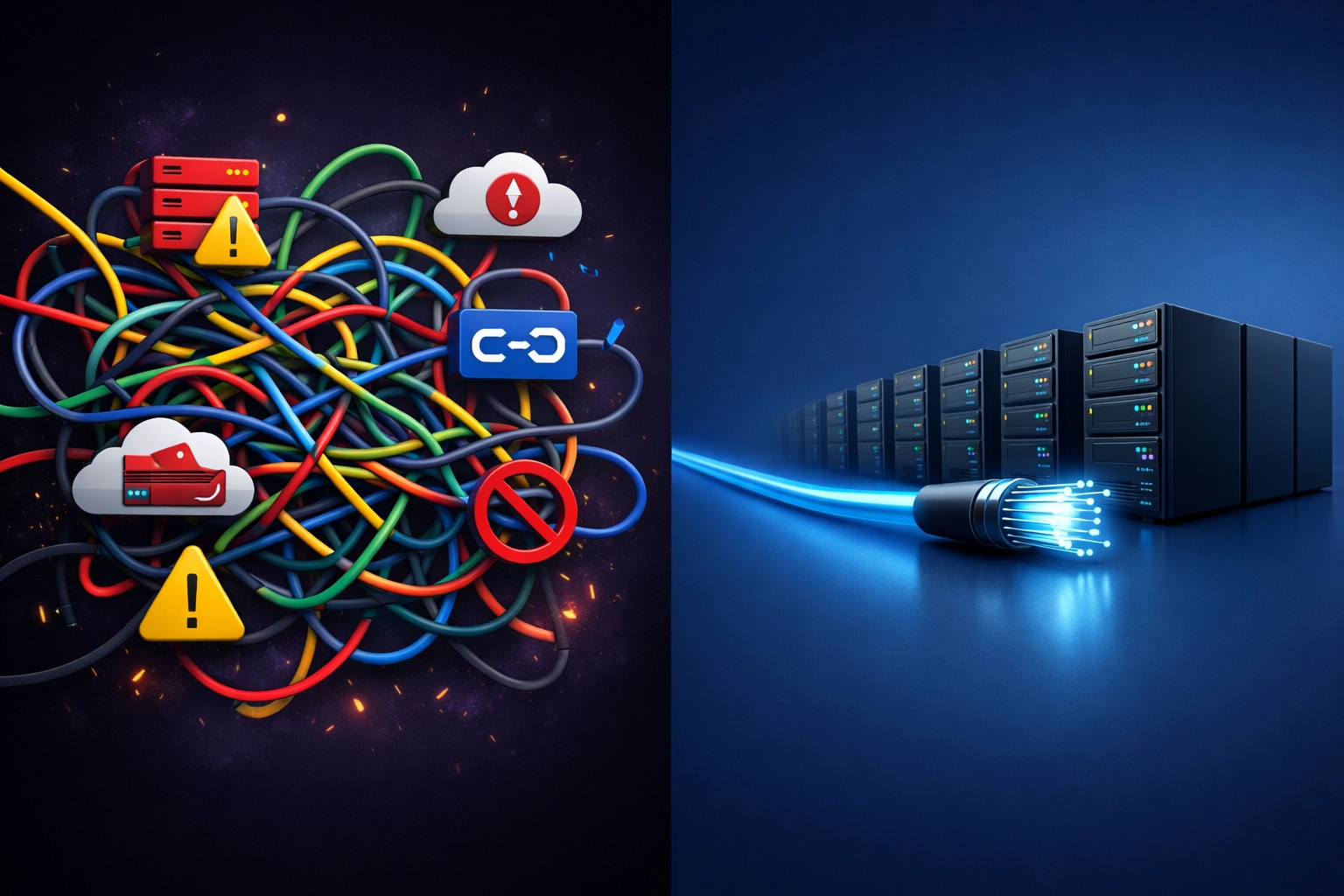
Each "best-of-breed" point solution seemed like the smart choice at the time. A specialized tool for network monitoring. Another for security alerts. A third for cloud management. By the fourth quarter of 2025, mid-market IT leaders found themselves managing an average of 15-20 separate vendor relationships: each with its own contract, portal, invoice, and support process.
The math stops making sense when you calculate the total cost of ownership. You're not just paying for software licenses. You're paying for the privilege of managing complexity itself.
The Hidden Tax of Point Solution Sprawl
When you deploy individual tools to solve individual problems, you inherit costs that never appear on the original quote:
Redundant licensing fees pile up when three different platforms offer overlapping capabilities. Your security stack might include threat detection from one vendor, log analysis from another, and incident response from a third: even though modern consolidated platforms can handle all three. Research shows organizations routinely pay for the same functionality twice across disconnected tools.
Integration overhead becomes a recurring expense. Every connection between systems requires custom development, ongoing maintenance, and troubleshooting when APIs change or vendors sunset features. Your team spends hours building bridges between platforms that were never designed to talk to each other.

Administrative complexity multiplies faster than you expect. Each vendor relationship demands procurement time, contract reviews, compliance audits, quarterly business reviews, and renewal negotiations. Your IT leadership team spends more time in vendor meetings than solving actual business problems.
Training fragmentation dilutes your team's effectiveness. When staff must learn 15 different interfaces, workflows, and support processes, proficiency suffers across the board. The productivity loss is measurable: 69% of IT leaders report that switching between core work tools causes significant workflow interruption.
The point solution model promises "best-of-breed" performance but delivers a hidden premium that grows every quarter.
The Consolidation ROI That CFOs Actually Care About
Consolidating your IT infrastructure isn't about simplicity for its own sake. It's about recovering margins that have been leaking into vendor sprawl for years.
Immediate cost reduction starts with decommissioning redundant tools. Organizations that audit their tech stack typically find 20-30% of their SaaS spending goes to duplicate or underutilized solutions. By consolidating to unified platforms, IT operations costs can drop by up to 80% in specific categories: not through service cuts, but by eliminating overlap and waste.
Volume negotiation leverage kicks in when you consolidate spend with fewer strategic vendors. Instead of scattering $500K across 20 point solutions with minimal purchasing power, you're bringing $400K (after eliminating redundancies) to 3-5 vendors where that spend commands attention, custom terms, and value-adds that weren't available before.
Maintenance cost elimination follows automatically. Fewer integrations mean fewer things to break. Fewer vendor relationships mean fewer contracts to track and renew. Your internal IT team shifts from maintenance mode to strategic work that actually moves business metrics.
The financial case compounds over time. First-year savings from consolidation typically fund the migration itself, while years two and three deliver pure margin recovery that flows directly to your bottom line.
Why 2026 is the Inflection Point for Mid-Market IT
Three forces are converging this year that make consolidation more urgent: and more valuable: than ever before.
AI requires consolidated data. The enterprises seeing measurable ROI from AI investments share one characteristic: they consolidated their infrastructure first. AI tools need unified, correlated telemetry across your entire stack to deliver accurate root cause analysis, predictive alerts, and intelligent automation. Fragmented point solutions generate data silos that AI can't penetrate. They produce noise instead of intelligence.
If you're planning AI initiatives for 2026-2027, consolidation isn't optional: it's the foundation those projects require to succeed.
Regulatory complexity is accelerating. Data privacy requirements, AI governance frameworks, and compliance obligations across multiple jurisdictions are forcing IT leaders to reduce their attack surface. Every vendor relationship represents a separate compliance footprint to audit, a separate data sharing agreement to review, and a separate risk exposure to manage.
Consolidated platforms dramatically simplify compliance by centralizing data handling, reducing the number of sub-processors in your vendor chain, and giving you unified visibility into your entire security posture.
Economic pressure demands fast payback. CFOs in 2026 are green-lighting initiatives that pay for themselves within 12 months while enabling future transformation. Platform consolidation is rare among IT investments because it delivers both: immediate recurring cost savings and reduced operational complexity that makes your team faster and more capable.
This isn't a "nice to have" modernization project. It's a defensive move that protects margins during uncertainty while positioning you for offensive growth when conditions improve.
The Operational Gains That Multiply Profitability
Cost savings tell half the story. Consolidation delivers performance improvements that compound your financial returns:
Faster incident resolution emerges when your monitoring, alerting, and remediation tools share a unified data model. Teams using consolidated platforms report reducing mean time to repair (MTTR) by 40-50% compared to fragmented tool chains. When your network monitoring, cloud management, and security operations run on integrated platforms, root cause analysis becomes straightforward instead of archeological.
One study found consolidated approaches improve root cause analysis accuracy to 95% while reducing downtime by 48% or more: metrics that translate directly to reduced revenue loss and better customer experience.
Expanded visibility coverage happens naturally. IT teams managing fragmented point solutions typically monitor 40-60% of their infrastructure because adding coverage to each specialized tool requires separate procurement, deployment, and training cycles. Consolidated platforms allow teams to monitor 2x or more of their IT assets with the same resources, closing critical blind spots that expose you to outages and security incidents.

Productivity recovery shows up in time-to-value for new initiatives. When your team isn't context-switching between 15 different portals and vendors, they can focus on projects that matter: optimizing cloud spend, improving network performance, or rolling out modern communication systems that actually work.
Making Consolidation Practical (Without the Risk)
The obstacle isn't whether consolidation makes financial sense. Mid-market IT leaders already know the math works. The obstacle is execution: how do you migrate critical infrastructure without business disruption, vendor lock-in, or choosing the wrong platform?
This is where having a single point of contact to source, evaluate, and implement becomes the difference between a successful consolidation and a stalled initiative that never launches.
Rather than navigating vendor sales teams directly: each promoting their own platform with limited objectivity: working with an advisory partner who represents your interests first changes the dynamic completely. You get:
- Vendor-neutral evaluation based on your actual requirements, not what sales teams want to sell
- Consolidated procurement that negotiates better terms because you're not managing 15 separate contracts
- Implementation coordination across network, voice, cloud, and security that prevents the integration headaches that plague DIY consolidation projects
- Ongoing optimization as your needs evolve, without getting locked into a single vendor's roadmap
At Premier Business Team, we've helped mid-market IT leaders assess their current infrastructure, identify consolidation opportunities, and execute multi-phase transitions that deliver savings in quarter one while building toward the modern, integrated stack that supports AI, compliance, and growth.
Frequently Asked Questions
How long does IT consolidation typically take?
Most mid-market organizations complete consolidation in 6-12 months using a phased approach that prioritizes high-impact, low-risk migrations first. Critical systems migrate last, after new platforms prove stability.
Will consolidation limit our flexibility or create vendor lock-in?
Modern consolidated platforms are far more flexible than legacy point solutions. The key is selecting vendor-neutral partners who prioritize interoperability and maintain relationships across multiple providers: giving you leverage and options rather than dependency.
What's the typical ROI timeline for infrastructure consolidation?
First-year savings from eliminated redundancies and reduced vendor overhead typically offset migration costs. Years 2-5 deliver pure margin recovery, with most organizations seeing 200-300% ROI over a three-year period.
How do we consolidate without disrupting operations?
Successful consolidations use parallel operation periods where old and new systems run simultaneously, gradual user migration, and careful timing around business cycles. Working with experienced implementation partners minimizes risk substantially.
Can smaller IT teams manage consolidated platforms effectively?
Consolidated platforms actually reduce the skill diversity required. Instead of needing specialists for 10 different tools, your team develops deep expertise in fewer platforms while automation handles routine tasks that previously required manual intervention across multiple systems.
Stop Paying the Premium: Start Recovering Your Margins
The point solution era made sense when specialized tools were the only way to solve specific problems. In 2026, that era is over.
Consolidated platforms deliver better performance, lower costs, and operational simplicity that fragmented tool chains can't match. Every quarter you delay consolidation is another quarter paying the premium for complexity itself.
Ready to see what consolidation could recover in your IT budget? Schedule a business technology assessment with Premier Business Team. We'll analyze your current vendor relationships, identify redundancies and consolidation opportunities, and map a phased approach that delivers savings while reducing risk. Contact us today to start turning vendor sprawl into competitive advantage.