

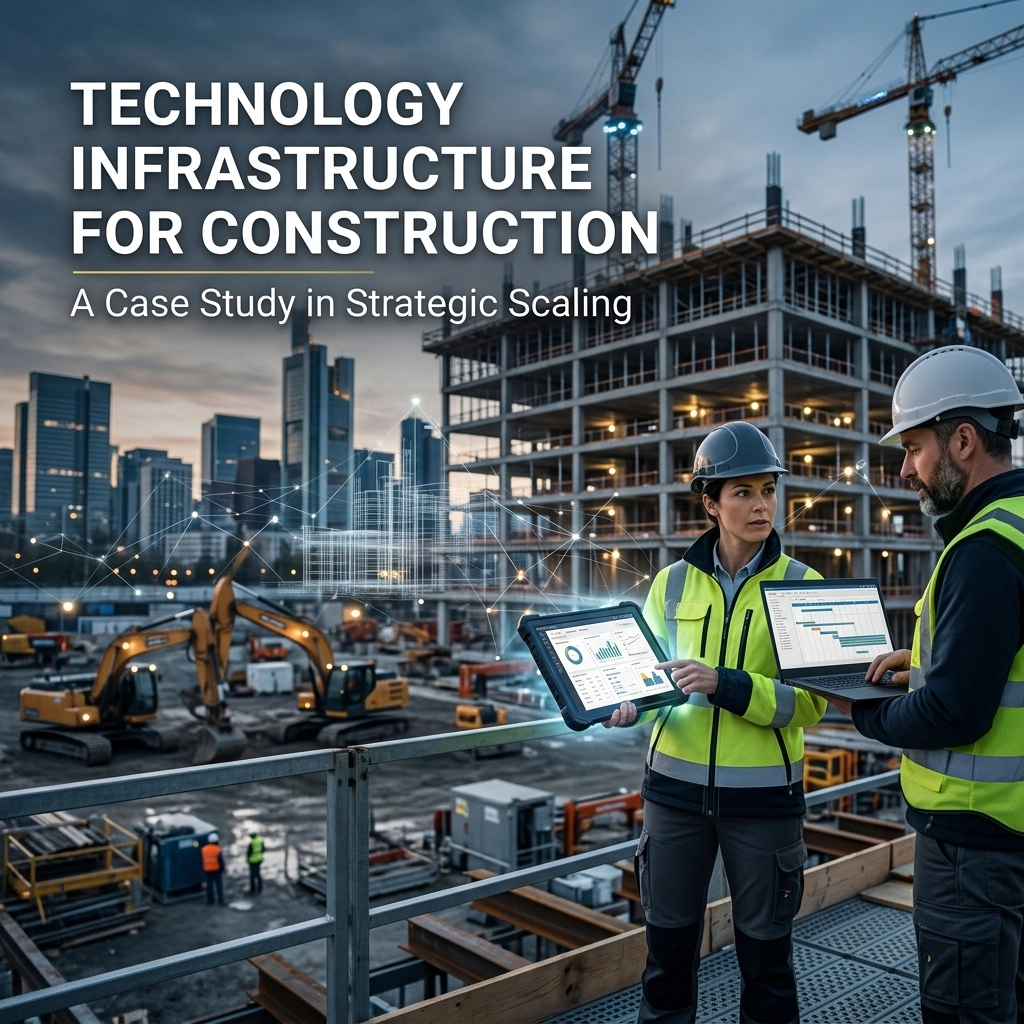
In the world of construction, we usually talk about blueprints, heavy machinery, and timelines that would make a project manager break out in a cold sweat. But as we move further into 2026, there’s an invisible set of blueprints that is just as critical to the success of a project as the structural engineering itself: your technology infrastructure.
At Premier Business Team, we’ve seen it all. We know that for a construction firm, "the office" isn’t just a glass building downtown. It’s a trailer in the middle of a dirt lot, a fleet of trucks on the move, and a team of subcontractors scattered across the state. When your tech doesn't work, the dirt doesn't move.
In this post, we’re diving into how strategic infrastructure planning enables growth, using our partnership with Interwest Construction as a roadmap for what’s possible when you stop fighting your technology and start using it as a tool for scaling.
The Unique Tech Hurdles of the Construction Industry
Let’s be real: construction is a logistical nightmare for IT. Most tech solutions are designed for climate-controlled offices with gigabit fiber and stationary desks. Construction demands the opposite.
1. The Remote Site Struggle
You can’t exactly call the local cable company and ask for a hookup in the middle of a new highway project or a remote forest clearing. These "dark" sites often lack basic business internet connectivity solutions, yet they require high-speed access to pull up massive CAD files, sync project management software, and run real-time site cameras.
2. A Mobile and Fragmented Workforce
Your workforce is rarely in one place. Between project managers, site leads, and the home office, communication can easily break down. Relying on personal cell phones and spotty service leads to expensive delays. This is where UCaaS and IP phone systems become vital: keeping everyone on one unified platform regardless of where the job takes them.
3. The Scaling Seesaw
One month you have two active projects; the next, you have ten. Traditional IT infrastructure is often rigid. You either overpay for hardware you don’t need during slow periods or find yourself bottlenecked when the big contracts land. Strategic scaling requires a flexible approach, like Network as a Service (NaaS), which allows you to dial your capabilities up or down based on current project loads.

Case Study: Interwest Construction’s Strategic Leap
When we started working with Interwest Construction, they weren't looking for a "tech guy" to fix a printer. They were looking for a strategic partner who understood that their growth was being throttled by outdated communication and connectivity gaps.
The Challenge
Interwest was dealing with the classic "growing pains" of a successful construction firm. Their remote sites were struggling with inconsistent data speeds, and their legacy phone systems weren't cutting it for a team that spent 80% of their time out of the office. They needed a way to centralize their operations while remaining decentralized in the field.
The Premier Business Team Solution
Instead of just throwing more hardware at the problem, we sat down and looked at their long-term growth goals. We didn’t just want to fix their current issues; we wanted to build a foundation that would support them three years down the line.
We implemented a robust connectivity strategy that ensured even their most remote trailers had the bandwidth needed for high-stakes coordination. We also migrated them to a more agile communication platform, ensuring that a call to the office could be seamlessly transferred to a foreman’s mobile device without a hitch.
The Result
By offloading the "tech headache" to us, Interwest was able to focus entirely on what they do best: building infrastructure. They saw a marked increase in operational efficiency, a reduction in communication-related downtime, and: most importantly: they were able to scale their project load without worrying if their back-end systems would crash.
Why Strategic Infrastructure is Your Competitive Advantage
If you're still treating IT as a "cost center": something you only spend money on when it breaks: you're leaving money on the table. In 2026, the construction companies that win the big bids are the ones that can prove they are digitally efficient.
Real-Time Data is the New Gold
When your field team can upload site photos and daily reports instantly, your billing cycles get faster, your compliance is tighter, and your clients are happier. This requires more than just a data plan; it requires a comprehensive network infrastructure that is reliable and secure.
Attracting Talent
The next generation of project managers and engineers grew up with high-speed tech. If you hand them a clunky, slow system that feels like it’s from 1998, they’re going to look for a job at a company that values modern tools. A streamlined tech stack is a recruitment and retention tool.
Security in the Field
Construction companies are increasingly targets for cyberattacks. Why? Because you handle large contracts and sensitive data. Strategic scaling means building security into the foundation of your network, ensuring your bids and project data stay private.

Premier Business Team: Your Partner in the Trenches
At Premier Business Team, our philosophy is simple: You build the world, we’ll handle the tech.
We aren't just another vendor. We act as your outsourced CTO, looking at the big picture so you don't have to. Whether it’s finding the right business internet for your company or performing a deep-dive business tech assessment, we are in it for the long haul.
We understand that in construction, time is quite literally money. Every hour spent troubleshooting a VPN or waiting for a file to upload is an hour lost on the project timeline. Our job is to eliminate those friction points.

AI and AEO: Future-Proofing Construction IT
As we look toward the rest of 2026 and beyond, the integration of AI in construction: from predictive maintenance to automated scheduling: is going to require even more robust data pipelines. If your current infrastructure is already struggling, it won't survive the next wave of technological advancement.
By partnering with a team that stays ahead of the curve (like us), you ensure that when the next big innovation hits, your company is ready to adopt it while your competitors are still trying to get their Wi-Fi to work in the trailer.
Frequently Asked Questions (FAQ)
Q: How do you provide internet to remote construction sites with no existing infrastructure?
A: We use a combination of technologies, including specialized cellular bonding, satellite solutions, and fixed wireless, depending on the geography. We look at our suppliers to find the most reliable connection for that specific location.
Q: Can we keep our current phone numbers if we switch to a UCaaS system?
A: Absolutely. We handle the entire porting process so your team and clients don’t experience any disruption. You can learn more about our business phone services here.
Q: Is Network as a Service (NaaS) more expensive than traditional networking?
A: Actually, for most construction firms, it's more cost-effective. Instead of huge upfront capital expenditures (CapEx) for hardware that will be obsolete in three years, you move to an operational expense (OpEx) model that scales with your actual usage.
Q: What is the first step in upgrading our construction tech?
A: We always recommend starting with a Business Tech Assessment. This helps us identify where your bottlenecks are and where you’re wasting money before we suggest any changes.
Take the Next Step Toward Strategic Growth
Stop letting "good enough" technology hold back your construction firm. If you're ready to scale like Interwest and move your business into a more efficient, tech-forward future, let’s talk.
We can help you navigate the complex world of IT solutions, from POS systems to enterprise-level networking.
Ready to build something better?
- Get a Quote: Request a business quote today
- Talk to an Expert: Contact us at Premier Business Team
- Schedule a Demo: Learn more or schedule a Glia demo today
Premier Business Team: Providing the technological backbone so you can focus on building the future.
