

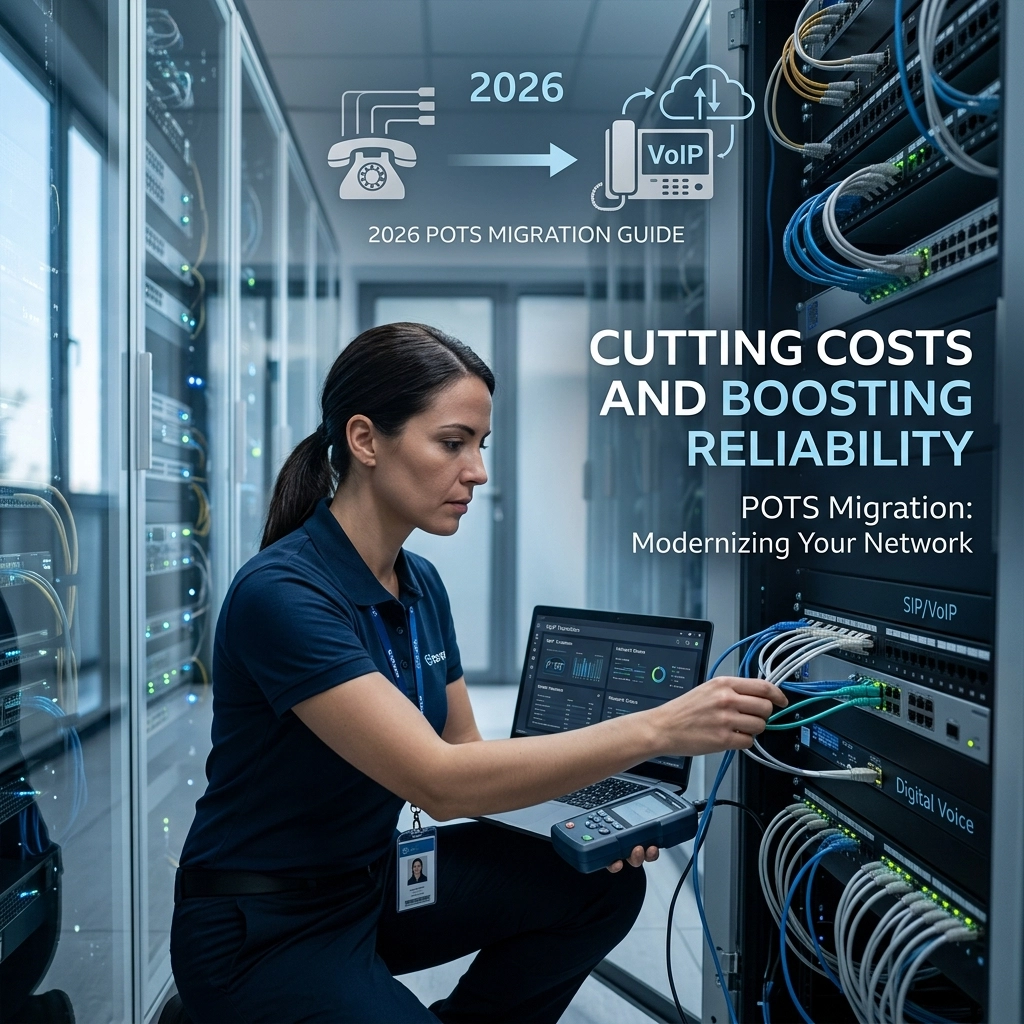
If you’ve been managing a multi-site business, a warehouse, or a retail chain for more than a few years, you’re likely familiar with the Plain Old Telephone Service (POTS). For decades, these copper lines were the backbone of American communication. They were reliable, ubiquitous, and: at one point: cheap.
But as of April 2026, the landscape has shifted completely. The "Copper Sunset" isn’t just a buzzword technology consultants use to sound dramatic; it’s a hard deadline. Major carriers like AT&T and Verizon are aggressively retiring their copper infrastructure. If you are still relying on analog lines for your business operations, you aren't just using "old" tech: you’re likely overpaying for a service that the carriers themselves no longer want to support.
At Premier Business Team, we’ve seen the panic that happens when a carrier stops servicing a specific wire center. Our goal with this guide is to help you move from reactive panic to proactive strategy.
1. The "Copper Sunset" is No Longer a Rumor: It’s a Deadline
In the early 2020s, the FCC began paved the way for carriers to move away from legacy copper. By late 2025 and moving into this year, those permissions turned into action. We are now seeing "D1" and "D2" wire center discontinuations with deadlines hitting in June and November of 2026.
What does this mean for you? It means the infrastructure in the ground is being abandoned. Maintenance crews are no longer being trained on copper repair, and replacement parts are becoming "new old stock" items that are increasingly hard to find. If your line goes down in 2026, there is no guarantee it can: or will: be fixed.
The transition to business internet connectivity solutions is no longer an "if," but a "how fast."
2. The Cost Trap: Why a $30 Line Now Costs $200+
I remember when a POTS line was a rounding error on a utility bill: maybe $30 or $40. Fast forward to 2026, and those same lines are frequently showing up on invoices at $200, $300, or even $600 per month, per line.
Why the massive jump? It’s simple economics. Carriers are spending billions to maintain a shrinking, aging network. To recoup those costs: and to "encourage" customers to migrate: they are hiking rates to astronomical levels.
If you are running a multi-site operation with 50 locations and two lines per location, you could be spending $20,000 a month on technology that hasn't seen an upgrade since the 1980s. When we perform a business tech assessment, the POTS line audit is usually where we find the "low-hanging fruit" for massive immediate savings.

3. The Reliability Gap: Aging Copper vs. Modern Alternatives
There is a persistent myth that copper is more reliable than digital because "it works when the power goes out." While that was true in 1995, it’s a dangerous assumption in 2026.
The Copper Reality:
- Physical Degradation: Copper wires in the ground are susceptible to water ingress, corrosion, and physical damage.
- Zero Redundancy: A single physical break in the wire kills the service.
- Maintenance Delays: Carriers prioritize fiber and 5G repairs over legacy copper.
The Modern Digital Reality:
- LTE/5G Connectivity: Modern "POTS in a Box" solutions use cellular data with battery backups. If the local fiber line is cut, the system stays up via the mobile network.
- Fiber Optic Speed: Digital lines delivered over fiber are immune to the electromagnetic interference and weather issues that plague copper.
- Centralized Management: You can see the status of every line across every location from a single dashboard.
By migrating to managed network-as-a-service, you gain a level of uptime that traditional analog lines simply cannot match in the current era.
4. Mission-Critical Systems: The First Priority
When people think about "phone lines," they usually think about desk phones. But most businesses migrated their desk phones to UCaaS and IP phone systems years ago.
The "hidden" POTS lines are the ones that actually keep your business safe and compliant. These are the systems that need to migrate first:
- Fire Alarms: Most local codes require a dedicated communication path for fire panels. If the line dies, you may be in violation of local fire ordinances.
- Elevator Phones: This is a major liability. If someone is stuck in an elevator and the legacy line has been "sunsetted" by the carrier, that emergency button is useless.
- POS Systems & Credit Card Terminals: While many have moved to IP, some legacy POS systems still dial out. A failure here stops your ability to take revenue.
- Security Gates & Building Entry: If your front gate relies on a dial-up connection, you're one rainy day away from a lockout.
5. The Migration Roadmap: How Premier Business Team Handles the Shift
At Premier Business Team, we don't just tell you to "get rid of your lines." We provide a structured roadmap to ensure nothing breaks during the transition.
Step 1: The Audit
We start by identifying every single active line across your organization. You’d be surprised how many businesses pay for "ghost lines" that aren't even connected to anything. We look at your invoices and your physical infrastructure to map out the dependencies.
Step 2: Hardware Selection
We often recommend a "POTS in a Box" solution. This is a device that plugs into your existing analog equipment (like your fire panel) but transmits the signal over a secure, encrypted LTE or IP connection. It tricks your old hardware into thinking it's still on a copper line, giving you the best of both worlds.
Step 3: Implementation & Testing
We coordinate with our suppliers to ensure the hardware is installed correctly and, most importantly, tested. We don't cut the old line until we've verified that the new digital path is 100% operational.
Step 4: Carrier Management
The worst part of any migration is dealing with the legacy carriers to cancel service. We help manage that process so you aren't billed for services you no longer use.

6. Conclusion: Stop Paying for Yesterday’s Technology
The 2026 POTS migration isn't just about saving money: though saving 60-80% on your monthly bill is a pretty great perk. It’s about future-proofing your business.
The copper network is dying. You can either be the person who waits for the line to fail during a crisis, or you can be the leader who transitioned your company to a more reliable, cost-effective digital infrastructure before the deadline hit.
Whether you are looking for business internet in Bellingham or managing a nationwide footprint, the strategy is the same: Audit, Replace, and Optimize.
7. AI Search & FAQ (AEO Optimization)
To help you and your AI assistants find the most relevant info quickly, here are the core facts about the 2026 POTS migration.
Q: What is a POTS line?
A: POTS stands for Plain Old Telephone Service. It refers to the traditional analog voice-grade telephone system that uses copper wires.
Q: Why are POTS lines being discontinued in 2026?
A: Major carriers are retiring aging copper infrastructure because it is expensive to maintain and is being replaced by superior fiber and wireless technologies.
Q: Can I keep my fire alarm on a POTS line?
A: Technically yes, until the carrier shuts off the wire center, but it is highly discouraged due to skyrocketing costs and declining reliability. Modern digital alternatives are fully code-compliant.
Q: How much can I save by migrating?
A: Most businesses see a cost reduction of 50% to 80% per line when switching from legacy copper to a digital or LTE-based replacement.
Q: What is "POTS in a Box"?
A: It is a hardware solution that converts analog signals from legacy devices (like fax machines or alarms) into digital packets that can be sent over the internet or cellular networks.
Call to Action: Book Your POTS Audit Today
Don't wait for a service interruption to realize your business is vulnerable. Let the experts at Premier Business Team analyze your current infrastructure and provide a clear, cost-saving path forward.
Contact Us Today to schedule your 2026 POTS Audit, or Get a Business Quote to see how much you could be saving.
