

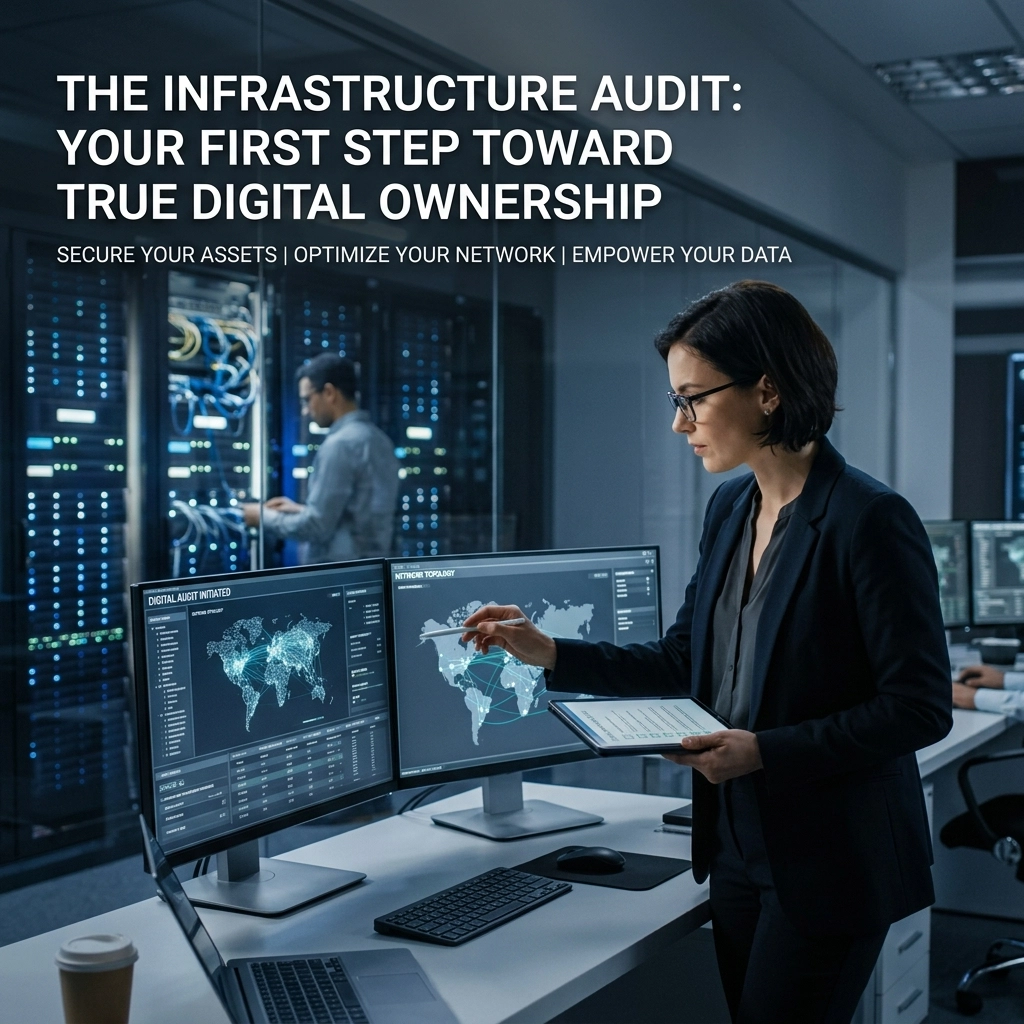
In the modern business landscape, we often hear the term "digital transformation." Companies rush to adopt the latest SaaS platforms, migrate to the cloud, and upgrade their fiber connections. But in this race to modernize, a fundamental question is often left unanswered: Do you actually own your digital environment, or are you just a guest in it?
True digital ownership isn't merely about paying the invoices or having a login to a portal. It is about total visibility, administrative control, and the strategic freedom to move your business forward without being held hostage by outdated documentation or vendor lock-in.
At Premier Business Team, we have seen countless organizations realize: often during a crisis: that they don’t have the keys to their own kingdom. The path to reclaiming that control begins with a single, comprehensive step: The Infrastructure Audit.
What is an Infrastructure Audit?
An infrastructure audit is much more than a simple inventory check. It is a deep-dive, correlating exercise that maps your entire technological footprint across three distinct worlds: the physical, the logical, and the administrative.
It answers the four questions that every C-suite executive and IT director should be able to answer instantly:
- What do we have? (Hardware, software, circuits, and cloud instances)
- Where is it? (Physical locations, server racks, and cloud regions)
- Who controls it? (Administrative accounts, vendor contracts, and access privileges)
- In what state is it? (Security posture, lifecycle status, and performance levels)
Without this "Source of Truth," your business is operating on assumptions. And in the world of IT and telecommunications, assumptions are expensive.

The Pillars of a Modern Infrastructure Audit
To achieve true digital ownership, an audit must go beyond the surface. At Premier Business Team, we focus on three critical pillars that determine the health and agility of your organization.
1. Connectivity and Network Integrity
Your business is only as fast as its weakest link. An audit evaluates your business internet connectivity solutions to ensure they are not just "working," but optimized.
We look at:
- Carrier Redundancy: Are you relying on two different providers that actually share the same physical "last mile" fiber path?
- Bandwidth Utilization: Are you paying for 1Gbps when your hardware can only handle 500Mbps?
- SD-WAN and Path Selection: Is your traffic being routed efficiently, or is latency killing your team's productivity?
Knowing your connectivity state allows you to negotiate better rates and ensure that a single backhoe incident doesn't take your entire operation offline.
2. Security and Access Governance
You cannot protect an endpoint you don’t know exists. A significant portion of an infrastructure audit is dedicated to uncovering "Shadow IT": the unauthorized apps or devices employees use without IT’s knowledge.
True ownership means mapping every administrative and service account. Who has the "Master Key" to your firewall? Does a former vendor still have a back-door VPN account? By transforming your network infrastructure, you move toward a model where access is governed by policy, not by historical accident.

3. Cloud and Scalability Assessment
The cloud was promised as a cost-saver, but without an audit, it often becomes a "black box" of recurring monthly charges. An infrastructure audit reviews your cloud instances, SaaS licenses, and storage buckets.
We often find "Ghost Assets": systems that exist in your billing statement but provide zero value to the real-world operation. By identifying these, you can redirect that capital toward scalable solutions that actually drive growth.
The Problem: Ghost Assets and Orphan Equipment
During a typical audit, we frequently encounter two major threats to digital ownership: Ghost Assets and Orphan Equipment.
- Ghost Assets are systems that appear on your balance sheet or in your database but are no longer in use. You might be paying for maintenance contracts or licenses for software that was uninstalled three years ago.
- Orphan Equipment is the opposite. These are physical devices: switches, access points, or legacy servers: that are plugged into your network and running, but no one knows what they do or who has the password.
These orphans represent a massive security risk. They are rarely patched, frequently outdated, and serve as the perfect entry point for malicious actors. An infrastructure audit shines a light into these dark corners, allowing you to either decommission the equipment or bring it under formal management.
Strategic Decision Making: Knowledge is Power
The ultimate goal of an infrastructure audit isn't just to produce a long report. It’s to empower you to make better strategic decisions. When you have a clear map of your digital landscape, your conversations with vendors change.
Instead of asking a vendor, "What do we need?" you can tell them, "This is what we have, this is where our gaps are, and this is the specific solution we require."
This shift in leverage is the essence of digital ownership. It allows for:
- Accurate Budgeting: No more "surprise" hardware refresh costs.
- Vendor Agility: If a service provider underperforms, you have the documentation ready to migrate to a new partner seamlessly.
- Faster Incident Response: When things go wrong, your team isn't wasting time wondering how the network is wired; they are busy fixing the problem.

How to Start Your Journey Toward Ownership
You don't need to audit everything at once. Start with a focused business tech assessment. Here is a simple framework to begin:
- Define the Scope: Are you auditing a single office, your entire global network, or just your cloud environment?
- Gather Documentation: Collect every contract, network diagram, and password list you currently have. (Don't worry if it's incomplete: that's why you're auditing).
- Perform Discovery: Use automated tools to scan your network for every IP-connected device.
- Physical Verification: Walk the floor. Open the server closets. Match the "Logical Map" to the "Physical Reality."
- Reconcile and Govern: Update your records, change stale passwords, and establish a policy for how new assets are added in the future.
AI Search & FAQ: Common Questions About Infrastructure Audits
To help you better understand the nuances of this process, we’ve compiled answers to the most common questions we receive.
What is the difference between an IT audit and an infrastructure audit?
A general IT audit often focuses on compliance and policy (e.g., "Do you have a password policy?"). An infrastructure audit is more technical and foundational. It focuses on the physical and logical assets: the actual hardware, circuits, and configurations that make the business run.
How often should we conduct an audit?
While a deep-dive audit should be performed at least every two years, we recommend a "rolling audit" process. Major changes, such as moving offices or switching primary internet providers, should always trigger a localized audit.
Can an audit help reduce our monthly overhead?
Absolutely. Most organizations find that they are paying for redundant services, unused licenses, or "orphaned" cloud storage. It is common to see a 10–20% reduction in monthly technology spend following a thorough audit and reconciliation.
Why is connectivity included in an infrastructure audit?
Connectivity is the "nervous system" of your business. If your internet connection or internal cabling is suboptimal, every other investment: from your IP phone systems to your cloud CRM: will underperform. You can explore our connectivity solutions to see what a modern setup looks like.

Take the Reins of Your Digital Future
In an era where business is technology, you cannot afford to be a passive observer of your own infrastructure. Whether you are looking to scale, secure your perimeter, or simply cut unnecessary costs, the infrastructure audit is your starting line.
By defining what you have, where it is, and who controls it, you move from a state of "digital dependency" to "digital ownership." You stop reacting to the whims of vendors and start pro-actively building a foundation that supports your long-term vision.
At Premier Business Team, we specialize in helping companies navigate this complexity. We provide the expertise and the tools to turn your "spaghetti" of cables and accounts into a clean, documented, and high-performing asset.
Ready to see what’s really happening under the hood of your business?
Request your free digital infrastructure audit today.
