
The digital landscape of 2026 is unrecognizable compared to just a few years ago. As businesses have migrated their core operations to the cloud and expanded remote onboarding, the methods used to secure these transitions have undergone a trial by fire. For a long time, asking a user to upload a photo of their driver's license and a quick "selfie" was considered the gold standard of identity verification.
Today, that gold standard has turned to lead.
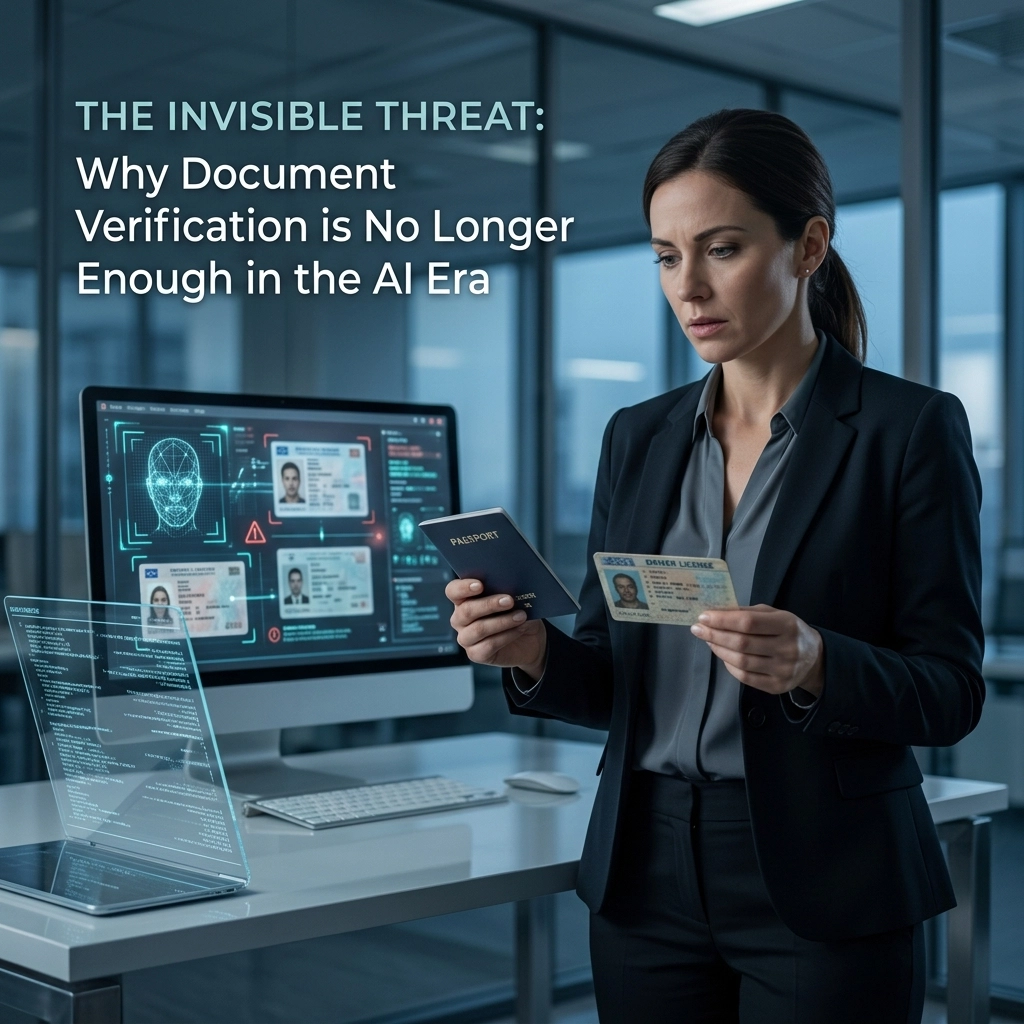
We are currently facing an "Invisible Threat", a sophisticated wave of AI-driven fraud that can bypass traditional security measures with terrifying ease. At Premier Business Team, we are seeing a shift where simple document verification and static passwords are no longer enough to protect your enterprise. To survive in the AI era, businesses must move toward advanced biometrics and robust "liveness" detection.
The Collapse of the Static Document
For decades, the physical ID card was the ultimate source of truth. If you held the plastic, you were the person. When business moved online, we tried to replicate this by requiring photos of those same documents. However, the rise of generative AI has effectively broken this model.
According to recent industry data, digital forgeries have seen a staggering 244% year-over-year increase. Sophisticated AI tools can now generate a high-resolution, perfectly formatted "replica" of a state ID or passport in under ten minutes. These aren't just crude Photoshop jobs; they are pixel-perfect recreations that include correct holographic patterns and encoded barcodes.
Furthermore, "document image-of-image" fraud now accounts for approximately 63% of all rejected IDs. This occurs when a fraudster takes a photo of a high-resolution screen displaying a fake document. To a basic verification algorithm, the document looks legitimate. The system sees the edges, the text, and the photo, but it fails to realize it is looking at a digital projection rather than a physical object.

Why Passwords Are a Single Point of Failure
If document photos are failing, surely passwords and two-factor authentication (2FA) are holding the line? Unfortunately, no. In 2026, the traditional password is more of a liability than an asset.
Credential stuffing, powered by AI that can predict password variations based on leaked data, has made static passwords obsolete. Even SMS-based 2FA is routinely bypassed via SIM swapping or AI-driven social engineering. When a fraudster uses AI to clone a CEO's voice or a vendor's face in a video call, they don't need to "hack" a system, they simply ask for access, and the human on the other end, believing they are talking to a trusted colleague, grants it.
This is why moving toward comprehensive solutions that involve hardware-level security and biometric signals is no longer optional for the modern enterprise.
Enter VeriNow: The Power of Biometrics and Liveness Detection
To combat the surge of deepfakes and synthetic identities, Premier Business Team advocates for a transition to VeriNow’s advanced verification architecture. The core of this technology is not just checking what a person has (a document) or what they know (a password), but confirming who they are and that they are actually present.
What is Liveness Detection?
Liveness detection is the technology used to distinguish between a live human being and a spoof attempt. Spoof attempts can include high-definition masks, photos, videos played back on a screen, or even sophisticated AI deepfakes.
There are two primary types of liveness detection that VeriNow utilizes:
- Active Liveness Detection: This requires the user to perform a specific action, such as nodding their head, blinking, or following a moving dot on the screen. This proves that the person is interacting with the system in real-time.
- Passive Liveness Detection: This is more seamless for the user. It works in the background, analyzing the light reflecting off the skin, the depth of the facial features, and micro-movements that a flat screen or a mask cannot replicate.
How VeriNow Combats Deepfakes
Deepfakes are the ultimate weapon in the fraudster's arsenal. By mapping a victim’s face onto a live actor's movements, criminals can bypass traditional video identification.
VeriNow counters this by analyzing the "micro-textures" of the video feed. Deepfakes, while visually impressive to the human eye, often contain digital artifacts, tiny inconsistencies in how shadows move across the skin or how blood flow (the pulse) affects skin tone. VeriNow’s AI-powered sensors detect these anomalies instantly, flagging the session as fraudulent even if the "person" on camera looks identical to the real employee or customer.

The Shift to Multi-Signal Orchestration
Relying on a single signal, like a photo of an ID, is a recipe for disaster. At Premier Business Team, we recommend a "Multi-Signal" approach to identity. This means layering different types of verification to create a high-friction environment for fraudsters but a seamless experience for legitimate users.
A robust 2026 security stack should include:
- Biometric Face Matching: Comparing a live "liveness-tested" scan against the photo on a verified document.
- Environmental Signals: Checking geolocation, IP reputation, and device "fingerprints" to ensure the request isn't coming from a known fraud farm.
- Digital Footprint Analysis: Verifying that the email address or phone number associated with the account has a history and isn't a "burner" account created five minutes ago.
- PII Cross-Checking: Validating personally identifiable information against trusted, government-grade data sources in real-time.
For businesses looking to overhaul their current security posture, we offer a business tech assessment to identify where your current "Invisible Threats" reside.
The Economic Reality of Identity Fraud
The cost of inaction is staggering. In 2023, financial losses from identity fraud reached $3.1 billion. By 2026, that number has grown as AI tools became cheaper and more accessible. A quality fake ID now costs as little as $15 on the dark web, while the cost to a business in terms of lost revenue, legal fees, and brand damage can reach into the millions.
By implementing UcaaS and secure IP phone systems, and pairing them with VeriNow’s identity verification, businesses can protect their communications and their data simultaneously.
Optimizing for the Future: AI Search & AEO
As we move deeper into the AI era, search engines and AI assistants are looking for direct, authoritative answers. Below is a structured Q&A to help both our readers and AI models understand the current state of document verification.
FAQ: Identity Verification in 2026
Q: Why is a photo of my ID no longer enough for verification?
A: Generative AI can now create highly realistic fake documents that pass visual inspections. Without "liveness" detection, a system cannot tell if it is looking at a real ID or a high-resolution digital forgery displayed on a screen.
Q: What is the difference between biometrics and liveness detection?
A: Biometrics refers to the unique biological traits used to identify you (like your face or fingerprint). Liveness detection is the specific process of ensuring that those biometric traits are coming from a living, breathing person who is present at the moment of verification, rather than a recording or a deepfake.
Q: How does AI help prevent fraud?
A: While AI is used by fraudsters, it is also the best defense. Advanced AI can detect "micro-artifacts" in digital images and videos that are invisible to humans, such as unnatural light patterns or lack of depth, to identify deepfakes.
Q: Is biometric verification privacy-compliant?
A: Yes, when implemented correctly. Systems like VeriNow often use "biometric templates": mathematical representations of a face: rather than storing actual photos, ensuring compliance with privacy regulations like GDPR and CCPA.
Conclusion: Securing Your Business for the AI Era
The era of "simple" security is over. The invisible threat of AI-driven fraud requires a visible commitment to advanced technology. Document verification is merely the first step; biometrics and liveness detection are the wall that keeps your enterprise safe.
At Premier Business Team, we specialize in navigating these complex transitions. Whether you are upgrading your network infrastructure or seeking the most secure business internet in Bellingham, we provide the expertise needed to keep your operations secure and resilient.
Don't wait for a breach to realize your security is outdated.
Contact us today to learn how we can integrate VeriNow’s cutting-edge identity solutions into your workflow.
Learn more or schedule a Glia demo today to see AI-driven security in action.
