

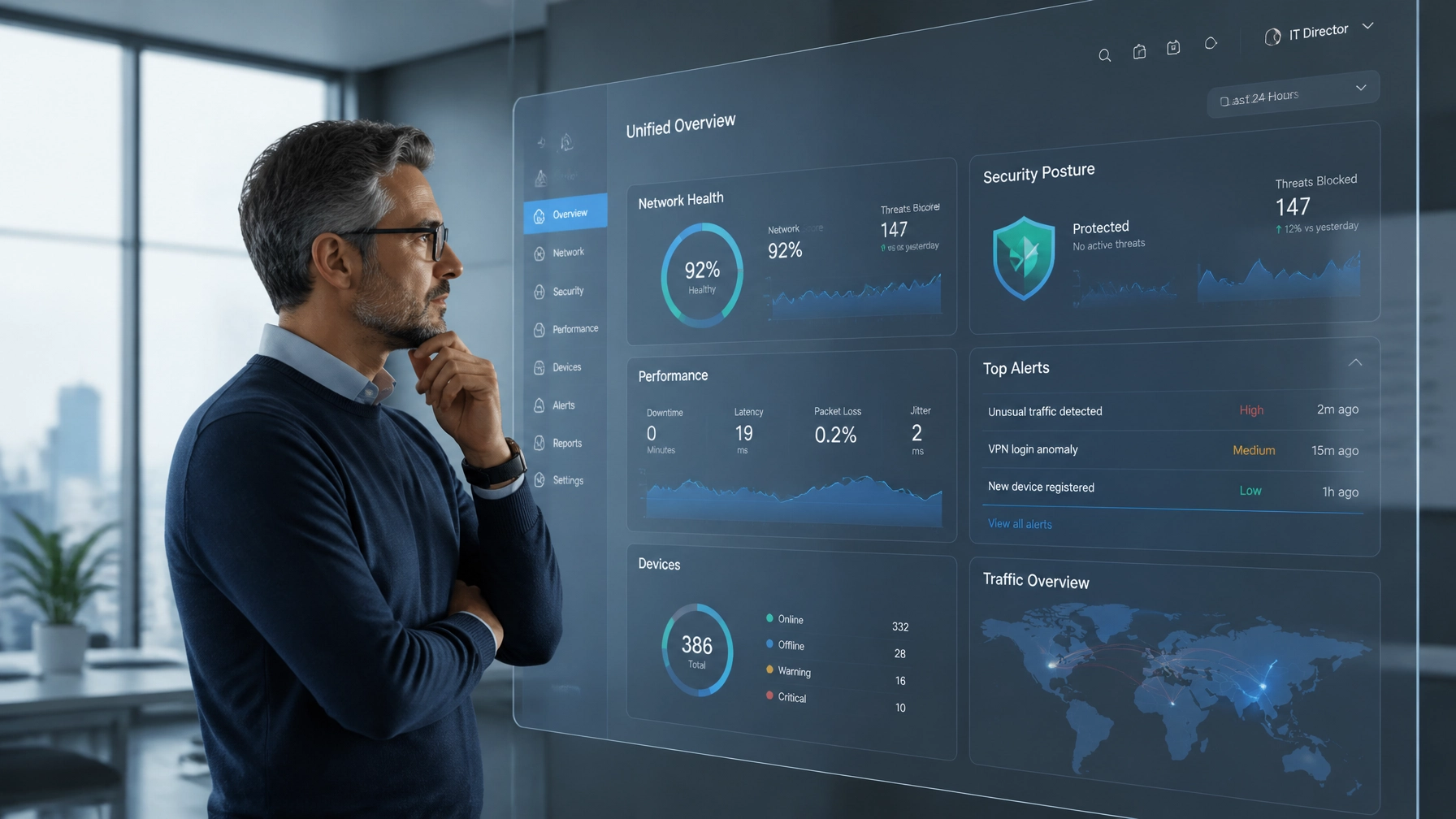
For David, an IT Director at a growing mid-market firm, the workday doesn’t start with innovation. It starts with a 50-item inbox filled with "Invoice Past Due" notices, renewal reminders from vendors he hasn't spoken to in a year, and support tickets where his ISP is blaming his firewall provider for an outage.
If this sounds like your morning, you are living in Vendor Chaos.
At Premier Business Team, we’ve seen this story across every industry, from financial institutions to regional restaurant chains. When you cross the threshold of managing 10 or more IT and telecom providers, your infrastructure stops being an asset and starts becoming a "complexity tax."
Research shows that vendor sprawl can quietly bleed 25% to 40% from your IT budget through hidden inefficiencies. Here is a breakdown of where that money is going: and how to get it back.
The "Invisible Tax": The Real Cost of Admin Overhead
Most IT managers track the price of a service, but few track the cost of managing it. Every single vendor you add to your stack requires:
- Vetting and Procurement: Researching, interviewing, and onboard.
- Accounts Payable: Processing invoices (which can cost between $15 and $40 per invoice in labor).
- Relationship Management: Quarterly business reviews, support escalations, and renewal negotiations.

The Math of Chaos:
If you manage 15 vendors and spend just two hours per month on each for admin tasks, that’s 360 hours a year: roughly nine full work weeks: lost to simply managing your tools rather than using them. For an overwhelmed IT team, that is time you can’t afford to lose.
Interactive Mental Audit: Are You Overpaying?
Take a moment to run these numbers in your head. If you answer "Yes" to more than two of these, your budget is currently leaking:
- Do you have more than one provider for cybersecurity? (e.g., one for endpoint, one for email, one for network).
- Are you paying for "bundled" services in one contract that overlap with standalone services in another?
- Do you have "Zombie Subscriptions": tools purchased for a project three years ago that are still auto-renewing?
- When there’s an outage, do your vendors spend the first hour pointing fingers at each other?
The "Duplicate Service" Trap
It is common for companies to pay for Cloud Services that include basic security features, while simultaneously paying a separate vendor for those exact same features. We often find that mid-market companies are paying for the same "seat" or "license" twice because their vendor ecosystem is fragmented.

The "Finger-Pointing" Penalty: Lost Productivity
When your internet goes down at a critical branch location, David doesn't care whose fault it is: he just needs it fixed. But in a high-vendor environment, the "blame game" is inevitable.
- Vendor A (ISP) says the circuit is up.
- Vendor B (Hardware) says the router is fine.
- Vendor C (Managed Service) says it's a configuration issue from Vendor A.
While they argue, your business is dark. The cost of this downtime: lost revenue, frustrated employees, and David’s own stress: often outweighs the monthly cost of the services themselves. Consolidating your Business Phone Systems & Unified Communications under a single advisor eliminates this friction.
Lost Leverage: Why Small Pieces Get Small Discounts
When you buy $1,000 of service from 10 different vendors, you are a "small fish" to all of them. You have zero negotiating power, no dedicated account manager, and you get the standard "off-the-shelf" pricing.
However, when you consolidate that $10,000 of spend through a single strategic partner, you gain Leverage.

At Premier Business Team, we act as your single point of contact. Because we represent a wide network of top-tier suppliers, we have the "bulk" influence to secure pricing and terms that David simply can't get on his own. We don't just find you a vendor; we find you the right solution at a price that reflects your total business value.
Security and Compliance Anxiety
For an IT manager in Healthcare or Banking, a single gap in a vendor's security posture can lead to a multi-million dollar compliance violation. Managing 12 different security SLAs is a nightmare. Consolidating into a unified Cybersecurity strategy ensures there are no "cracks" between providers for hackers to exploit.

How to Stop the Bleeding (For Free)
The most frustrating part for many IT Directors is that they know they are overpaying, but they don't have the 40 hours required to audit every contract and find the savings.
That is where we come in.
Premier Business Team provides a Vendor Consolidation Assessment at no cost to you. Most of our services are paid for by the providers we represent, meaning you get a high-level technology consultant for free. We will:
- Audit your current invoices and contracts.
- Identify overlaps, "zombie" services, and overcharges.
- Consolidate your stack into a streamlined, high-performance infrastructure.
- Manage the transition so you can get back to your actual job.
Stop being a "Vendor Manager" and start being an IT Director again.
Ready to reclaim 30% of your budget?
Contact Premier Business Team today for a free, no-obligation assessment of your current IT and telecom stack.
- Call us: 360-946-2626
- Get Started Online: Free General Inquiry & Assessment Form
- Visit our website: https://premierbusinessteam.com
Frequently Asked Questions (FAQ)
What are the main hidden costs of having too many IT vendors?
The primary hidden costs include administrative labor (processing multiple invoices), "finger-pointing" during technical support issues which increases downtime, and "duplicate spend" where different vendors provide overlapping services.
How much can I save by consolidating my IT vendors?
Most mid-market businesses find they can save between 15% and 40% of their total IT budget by eliminating redundant services and leveraging the pricing power of a consolidated contract.
Does vendor consolidation increase my risk of a "single point of failure"?
Actually, it often decreases risk. When you have a single trusted advisor like Premier Business Team, we ensure your consolidated stack has built-in redundancies and that your security protocols are unified across all platforms, leaving fewer gaps for errors or breaches.
How much does a vendor audit cost?
At Premier Business Team, our initial assessments and most of our consulting services are free to the client. We are compensated by the providers, allowing us to act as a neutral advisor focused solely on finding the best fit for your business.
