

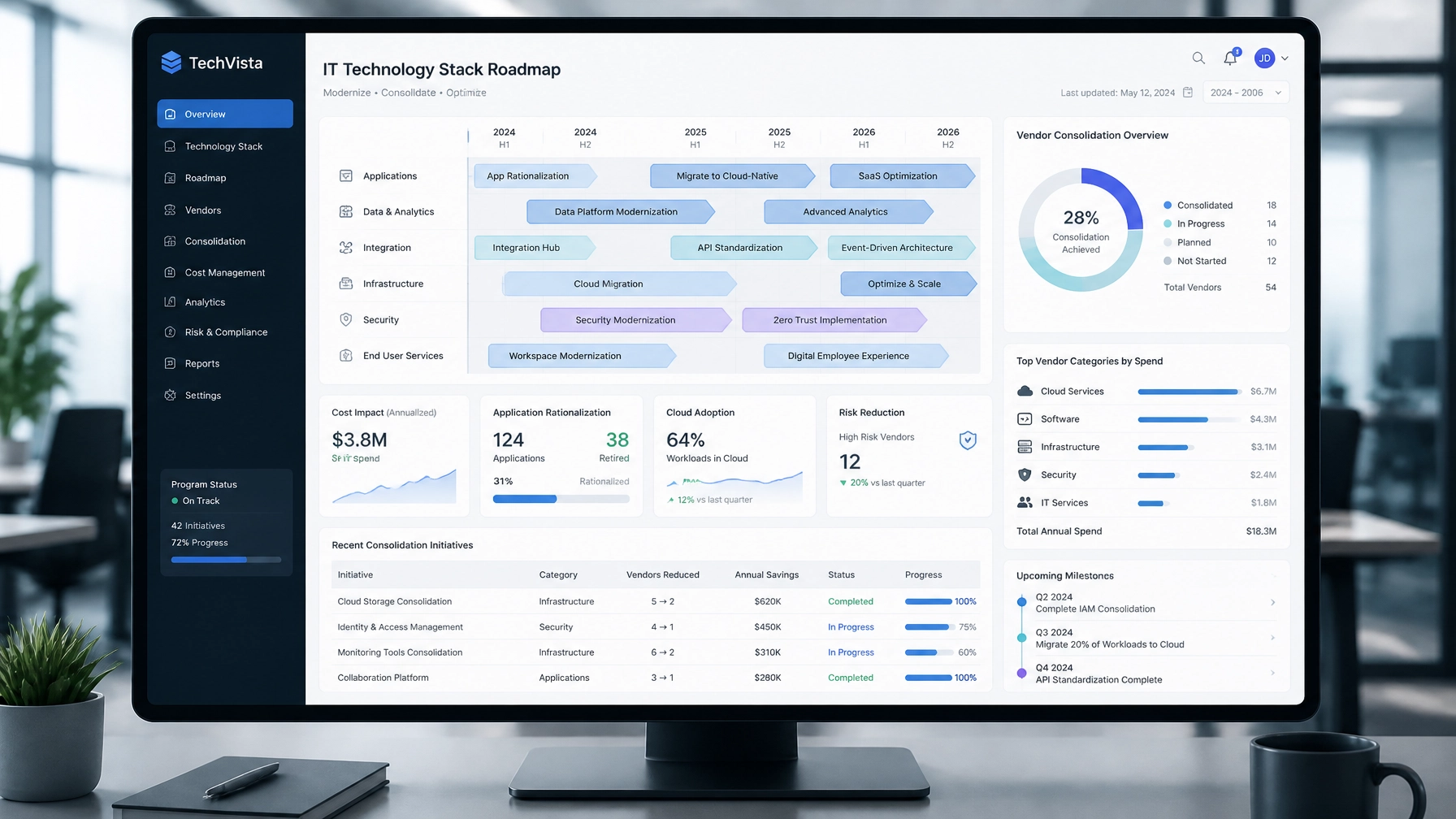
If you are an IT Director, VP of Operations, or IT Manager at a mid-market company, your daily reality likely feels like an endless balancing act. Studies and executive feedback show that modern IT leaders spend upwards of 60% of their time firefighting day-to-day user issues, network hiccups, and security alerts, leaving precious little time for strategic planning. The remaining 40% is frequently consumed by budget anxiety, spiraling software license renewals, and managing a sprawling roster of 10 to 30 different technology vendors.
Over the years, "point solution creep" quietly takes over. Every department adds their preferred collaboration tool, security overlay, or cloud backup utility. Before you know it, you are paying multiple bills for overlapping capabilities, dealing with finger-pointing when integrations fail, and struggling to maintain visibility across your infrastructure.
Implementing a structured IT vendor consolidation strategy is no longer just a nice-to-have cost-cutting exercise: it is a survival imperative for understaffed IT teams. Industry benchmarks reveal that 68% of IT leaders are actively consolidating suppliers, achieving average net savings of 14% to 30% while dramatically reducing operational overhead.
What is IT vendor consolidation and why is it urgent?
Direct Answer: IT vendor consolidation is the strategic process of auditing, rationalizing, and reducing your organization's technology suppliers: combining siloed point solutions onto unified platforms to eliminate redundancy, slash administrative overhead, and reduce total IT spending by 15% to 30%.
For mid-market organizations with 150 to 500 employees, supplier fragmentation creates severe operational drag. When your phone system is through one provider, your SD-WAN connectivity through another, your cloud storage on a third, and your endpoint security managed by a fourth, your lean internal team spends more time coordinating vendor support tickets than driving revenue-generating initiatives.
Furthermore, "The Great Infrastructure Reset" has brought rising hardware costs and unpredictable renewal spikes. Without consolidation, mid-market companies hemorrhage budget on unused software licenses and redundant infrastructure support fees.
How do you audit your current IT stack to find hidden redundancy?

Direct Answer: To audit your IT stack, aggregate every recurring invoice, software subscription, telecom contract, and maintenance agreement into a single master inventory, mapping each tool directly to its business function to identify overlapping capabilities and dormant licenses.
The first step in any successful consolidation roadmap is uncovering where your money is actually going. Most IT leaders are shocked to discover that up to 25% of their software licenses are underutilized or completely abandoned by staff.
To execute a comprehensive audit:
- Pull All Financial Records: Review accounts payable, corporate credit card statements, and enterprise resource planning (ERP) systems to capture every recurring technology expense over the past 12 months.
- Catalog Contract Renewal Dates: Document exact expiration dates, auto-renewal clauses, and penalty terms for every telecom circuit, cloud provider, and software vendor.
- Map Tools to Business Outcomes: Ask department heads which core business processes rely on each tool. If three different departments are using three different project management or file-sharing utilities, you have an immediate consolidation target.
To streamline software spending and eliminate bloated licensing overheads without impacting end-user productivity, explore our specialized Software Licensing advisory services.
What are the 5 steps to successfully execute an IT stack rationalization?

Direct Answer: Executing a successful IT stack reduction requires a rigorous 5-step roadmap: (1) Comprehensive Discovery & Spend Audit, (2) Functional Redundancy Mapping, (3) Tier-1 Platform Standardization, (4) Contract Alignment & Phased Migration, and (5) Vendor-Neutral Managed Governance.
Step 1: Comprehensive Discovery & Spend Audit
Begin by gathering all baseline inventory data. Document current bandwidth utilization, cloud storage volumes, phone system seat counts, and security tool deployments. Establishing this baseline allows you to measure ROI accurately as you streamline.
Step 2: Functional Overlap & Redundancy Mapping
Analyze your stack by category (e.g., security, collaboration, cloud storage, and network connectivity). Identify where point solutions overlap with broader platforms you already own. For example, many businesses pay separately for advanced security or collaboration tools while maintaining enterprise-grade suites like Microsoft 365 that include robust native capabilities.
Step 3: Platform Rationalization & Core Standardization
Standardize on unified platforms. Instead of juggling separate vendors for voice, video, chat, and contact center technology, consolidate onto modern Unified Communications (UCaaS) and Contact Center (CCaaS) ecosystems. Similarly, unify your network architecture and remote connectivity through streamlined SD-WAN solutions.
Step 4: Contract Alignment & Phased Migration Planning
Avoid abrupt cancellations that cause business disruption. Map out a 12-to-36-month migration calendar synchronized with your major contract expiration dates. This avoids costly early-termination fees while systematically rolling expiring agreements into your consolidated architecture.
Step 5: Vendor-Neutral Sourcing & Managed Governance
Partner with an experienced technology advisor to source replacement contracts, negotiate enterprise discounts, and manage ongoing vendor relationships under a single umbrella.
For a deeper dive into optimizing your overarching operational overhead, review our guide on Utility Cost Optimization.
How does vendor-neutral advisory eliminate the pain of consolidation?

Direct Answer: Vendor-neutral advisors act as a single point of contact to evaluate, source, and implement consolidated technology solutions across top-tier providers, removing the bias of single-vendor reps and saving internal teams hundreds of hours of procurement friction.
When IT directors attempt vendor consolidation on their own, they often run into a brick wall of aggressive vendor account managers, complex pricing structures, and technical friction during data migration. Single-vendor providers will always push you toward their proprietary ecosystem: even when an open, multi-vendor integrated platform better serves your long-term growth.
This is where Premier Business Team changes the game. Operating as a trusted, vendor-neutral technology advisor, we sit on your side of the table. We evaluate options across top industry providers, deliver clear recommendations tailored to your exact budget, and manage deployment end-to-end.
Whether you are looking to fortify your defenses with our robust Cybersecurity Solutions or streamline day-to-day operations through comprehensive Managed IT Services, we bring all your technology solutions under one roof. Best of all, most of our advisory services are free and paid for by the providers we represent.
What results can mid-market IT leaders expect from consolidation?
When executed with a disciplined roadmap, vendor consolidation delivers transformative financial and operational returns:
- 14% to 30% Net Cost Reductions: Directly eliminating redundant subscriptions and optimizing telecom and cloud spend yields immediate bottom-line relief. For instance, a mid-market financial services firm recently reduced software and telecom vendors from 47 down to 22, unlocking over $460,000 in annual recurring savings.
- Up to 30% Lower Support Overhead: Fewer disparate systems mean fewer vendor finger-pointing sessions, simpler troubleshooting, and drastically reduced administrative friction for your lean 1-to-3 person IT staff.
- Reclaimed Staff Hours: Shifting internal IT focus away from routine firefighting and vendor billing disputes back toward strategic innovation and business growth.
Schedule Your Business Outcome Assessment
Stop letting fragmented vendors and spiraling software costs drain your budget and overwhelm your team. Let Premier Business Team help you cut your IT stack in half, simplify your infrastructure, and secure enterprise-grade performance.
Schedule a Business Outcome Assessment today or call our expert advisors directly at 360-946-2626.