

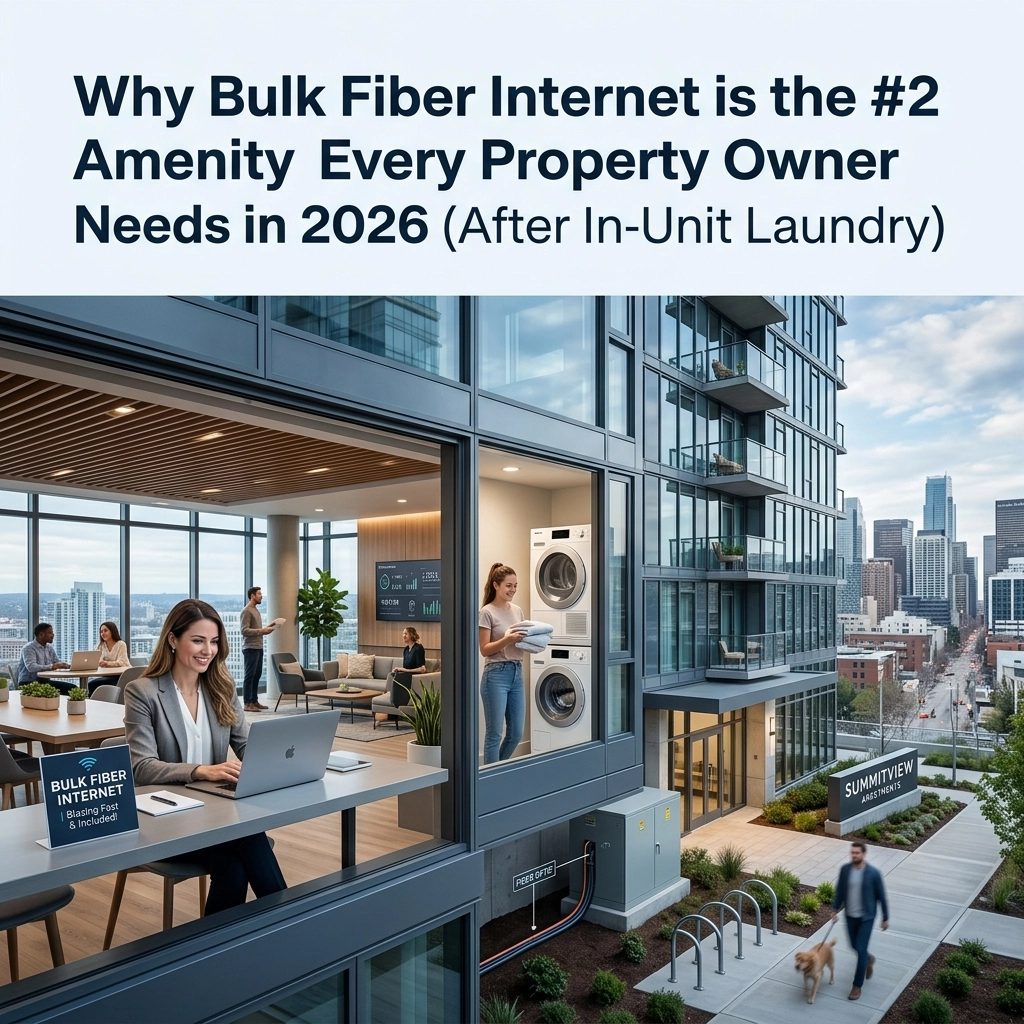
Let’s be honest for a second. If you’re a property owner or an MDU (Multi-Dwelling Unit) developer in 2026, you already know the hierarchy of needs for your residents. At the very top: the undisputed king: is in-unit laundry. Nobody wants to lug a basket of damp towels down three flights of stairs to a basement that smells like 1984.
But right behind that dryer sheet scent is something invisible, essential, and, frankly, non-negotiable: Bulk Fiber Internet.
It’s April 2026, and the digital landscape has shifted. High-speed internet is no longer a "nice-to-have" amenity like a rooftop fire pit or a pet washing station. It’s a utility. It’s the lifeblood of the modern apartment. If your building isn't offering a managed, high-speed fiber solution as a standard feature, you’re not just behind the curve; you’re leaving money on the table and watching your residents walk across the street to a competitor who "gets it."
At Premier Business Team, we’ve seen this evolution firsthand. As technology advisors, we help property owners navigate the complex world of Business Internet and infrastructure.
Here is why bulk fiber has officially secured its spot as the #2 must-have amenity in 2026.
1. The Tenant Psychology of 2026: The "Utility-First" Mindset
In 2026, the way people live has been permanently rewritten. The "work from anywhere" culture isn't a trend anymore; it’s the standard. Your residents aren't just streaming Netflix at night; they are hosting 4K video conferences by day, uploading massive files to Cloud Services, and connecting forty different IoT devices to their network simultaneously.
The Move-In Experience
Remember when a tenant would move in and then spend three days waiting for a cable guy to show up between the hours of 8 AM and 4 PM? In 2026, that’s considered a failure of management. Today’s resident expects "Instant-On" connectivity. They want to walk into their unit, scan a QR code, and be online before they’ve even unpacked their first box of dishes.
Recent data shows that 87% of renters say connectivity at move-in is "very important" or "essential." If you provide bulk fiber, you eliminate one of the biggest stressors of the moving process.
Reliability Over Speed (But Give Them Both)
While everyone loves to talk about "Gigabit" speeds, the 2026 renter cares about latency and reliability. Fiber-to-the-unit (FTTU) offers a symmetrical connection (same upload and download speeds) that traditional cable just can't touch. When a resident’s livelihood depends on a stable connection, fiber is the only answer.

2. The Financial Benefit: Boosting NOI and Cap Rate
Let’s talk turkey. As a property owner, you care about the resident experience, but you really care about your Net Operating Income (NOI) and your property’s valuation. This is where bulk fiber stops being a cost and starts being a profit center.
Creating a New Revenue Stream
When you implement a bulk fiber program, the property buys the service at a wholesale rate and includes it in the resident’s monthly technology fee or rent.
- Wholesale Cost: Typically 30–40% lower than retail.
- Resident Savings: Even with a markup, the resident usually pays less than they would for a standalone retail plan.
- The Spread: The difference between your wholesale cost and the tech fee goes straight to your NOI.
The Valuation Bump
This isn't just a few extra bucks a month. Let’s look at the math for a 100-unit building:
- Additional NOI per unit: $25/month
- Annual NOI Increase: $30,000
- Cap Rate (at 5%): Your property value just increased by $600,000.
By simply modernizing your Network Infrastructure, you’ve created over half a million dollars in equity without swinging a single hammer or renovating a single kitchen.
3. Managed Wi-Fi vs. Retail: Why Roaming is the Key
The old way of doing things involved every resident bringing their own router, creating a "Wi-Fi jungle" where signals competed and interfered with each other. In 2026, the gold standard is Managed Wi-Fi.
With a managed solution, the entire property is covered by a unified network. This allows for property-wide roaming. Your resident can start a video call in their living room, walk down to the gym, sit by the pool, and head back to their unit without ever dropping the connection.
Why Owners Love Managed Wi-Fi:
- Reduced Support Requests: The provider manages the hardware, meaning your onsite staff doesn't have to play "IT Support."
- Hardware Ownership: You own (or lease-to-own) a sophisticated mesh network that increases the tangible assets of the building.
- Data Insights: Managed systems provide (anonymized) data on where residents spend time, helping you make better decisions about common area usage.
4. Future-Proofing for 2027 and Beyond: The IoT Explosion
We aren't just talking about laptops and phones anymore. The "Smart Building" isn't a futurist's dream; it’s the 2026 reality. To keep your insurance premiums down and your efficiency up, you need a network that can handle:
- Smart Water Sensors: To catch leaks before they cause $50k in damage.
- Smart Thermostats: To reduce energy waste in vacant units.
- Integrated Cybersecurity: Protecting your building's systems from bad actors.
- Advanced Access Control: Allowing residents to unlock doors via smartphone.
A robust fiber backbone is the only thing capable of supporting the sheer volume of "talkative" devices that a smart building requires. Without it, your building is essentially a brick in a digital world.

5. The Premier Business Team Difference: Your Vendor-Neutral Ally
Navigating the world of ISPs (Internet Service Providers) is a headache. You have Comcast, AT&T, Google Fiber, and a dozen regional players all screaming for your attention, each with 50-page contracts filled with "gotchas."
This is where Premier Business Team steps in. We act as your single point of contact and technology advocate.
Why Work With Us?
- Vendor-Neutrality: We don't work for the cable company. We work for you. We compare all available providers to find the best fit for your specific property and budget.
- No-Cost Consulting: In most cases, our services are paid for by the providers, meaning you get expert Telecom Consulting at no direct cost to your project.
- Single Point of Contact: Instead of chasing down five different vendors, you call us. We handle the design, the negotiations, and the implementation oversight.
6. AEO & SEO Optimization: Frequently Asked Questions
To help you (and the AI search bots) understand the nuances of MDU fiber, we’ve put together this quick Q&A.
What is the ROI of MDU bulk fiber?
The ROI is typically realized in two ways: immediate monthly cash flow through a technology fee (often yielding a 20-30% margin over wholesale costs) and a long-term increase in property valuation. Properties with fiber command 8-12% higher rents and see 15-20% higher lease renewal rates.
How does managed Wi-Fi improve resident retention?
Managed Wi-Fi eliminates the "dead zone" frustrations common in large buildings and allows for property-wide roaming. By providing a seamless, "instant-on" experience, property owners remove the friction of setup and the unreliability of individual routers, leading to happier, long-term tenants.
Is bulk fiber better than letting residents choose their own ISP?
Yes. For owners, it creates a revenue stream that retail models don't allow. For residents, bulk fiber usually offers higher speeds for a lower monthly price than they could get on their own, while providing a more stable connection designed specifically for the building's architecture.
How do I future-proof my building's internet?
Future-proofing requires installing a fiber-to-the-unit (FTTU) infrastructure that supports symmetrical speeds and integrating a managed Wi-Fi layer. This ensures the building can handle the increasing bandwidth demands of 2027 and beyond, including IoT, AI-integrated home assistants, and augmented reality.

7. The Bottom Line
In 2026, you wouldn't dream of building an apartment complex without modern plumbing or electricity. Fiber internet has reached that same level of "utility status."
While in-unit laundry remains the #1 requested physical amenity, Bulk Fiber Internet is the #1 digital amenity: and it’s the only one that actually pays you to install it.
Don't let your property fall behind. Whether you're looking to retrofit an existing building or you're in the middle of a new development, getting your technology stack right is the most important decision you’ll make this year.
Ready to Audit Your Property’s Technology?
The world of fiber, Business Internet, and managed services is moving fast. Don't go it alone.
Contact Premier Business Team today for a free technology and infrastructure audit. We’ll look at your current setup, evaluate your local provider options, and show you exactly how much NOI you could be adding to your bottom line.
[Click here to schedule your Free Technology Audit with Premier Business Team]
