• Skip to primary navigation
  • Skip to main content
Premier Business Team

Premier Business Team

Your business connectivity and IT Team

  • Home
  • Business Internet
  • Business Phone
  • Blog
  • About Us
    • Our Featured Suppliers
  • Contact Us
  • Business Quote
    • Business Tech Assessment
  • Engineering
  • Call: 360-946-2626
  • Show Search
Hide Search

Blog Posts

Infrastructure as a Service (IaaS): Scalable Cloud Solutions for Growing Businesses

premierbusiness · February 19, 2026 ·

Here's the reality for most growing businesses: You've got momentum. Sales are climbing. Your team is expanding. Everything looks great on paper.

But behind the scenes? Your IT infrastructure is quietly becoming a bottleneck. Server costs are climbing faster than your revenue. You're calling support and waiting hours for callbacks. Your team is complaining about slow systems. And you're stuck in a cycle where scaling your business means scaling your IT problems right alongside it.

Sound familiar? You're not alone: and there's a better way forward.

What Is Infrastructure as a Service (IaaS)?

Infrastructure as a Service (IaaS) is a cloud computing model that delivers the foundational IT resources your business needs: servers, storage, networking, and virtualization: without the hardware headaches.

Instead of buying physical servers, maintaining server rooms, paying for cooling systems, and employing full-time staff to keep everything running, you access enterprise-grade infrastructure on demand. You pay only for what you use, scale up or down as needed, and let a managed cloud provider handle the heavy lifting.

Think of it like leasing office space instead of buying a building. You get everything you need to operate effectively, but without the massive upfront investment, ongoing maintenance costs, or long-term commitment to outdated equipment.

Modern cloud server infrastructure with IaaS managed services for enterprise businesses

The Problem: Growth Shouldn't Feel Like a Penalty

Most businesses don't set out to create infrastructure problems. The issues creep up gradually as you grow:

Rising IT Costs That Don't Match Your Growth

You added 15 employees last year, but your IT costs went up 40%. You're paying for server capacity you don't use most of the time "just in case" you need it during peak season. Hardware refresh cycles hit your budget like clockwork, and every upgrade feels more expensive than the last.

Limited Visibility Into What's Actually Happening

When something goes wrong, you're flying blind. Is it a network issue? A server problem? A storage bottleneck? You're piecing together information from multiple vendors and hoping your internal IT person can figure it out before the business is impacted. (If you want a clearer framework for modern WAN infrastructure, see our guide: What is SD-WAN? A Business Guide.)

Slow Support That Can't Keep Up

You submit a ticket and wait. Then you follow up. Then you wait some more. Meanwhile, your team is sitting idle, customers are getting frustrated, and you're losing productivity: and revenue: by the hour.

Scaling Feels Impossible Without Major Investment

Opening a new location? Rolling out a new application? Expanding your team? Every growth move requires months of planning, major capital expenditure, and infrastructure projects that pull your IT resources away from strategic work.

The worst part? You know your competitors aren't dealing with this. They're moving faster, spending less, and somehow their systems just… work.

The Solution: Managed IaaS Built for Real Business Needs

A properly deployed Infrastructure as a Service platform eliminates the traditional tradeoffs between cost, performance, and scalability.

Comparison of cluttered legacy IT systems versus clean modern cloud IaaS infrastructure

Flexibility Without Complexity

IaaS gives you access to enterprise-grade infrastructure that adapts to your business. Need more storage next month? Done. Expanding into a new region? Spin up resources in minutes, not months. Testing a new application? Deploy it without buying new hardware or reconfiguring your entire network.

The infrastructure scales with you: not ahead of you or behind you.

Performance You Can Actually Feel

Managed IaaS providers operate geographically distributed data centers with redundancy built into every layer. That means faster load times, better responsiveness, and systems that stay online even when individual components fail.

Your team notices the difference immediately. Applications respond faster. File transfers complete quicker. Video calls don't freeze during important meetings. It's the kind of performance you'd expect from a Fortune 500 company: because you're running on the same infrastructure they use.

Compliance and Security Built In

Data breaches, compliance violations, and security gaps keep business owners up at night. With managed IaaS, you get automatic data backups, multi-factor authentication, encryption, disaster recovery, and compliance frameworks built into the platform. (For a deeper look at how to approach security program-wide, read: Cybersecurity Risk Management.)

You're not adding security as an afterthought. It's baked into every layer of the infrastructure from day one.

The Outcomes: Real Results for Growing Businesses

When businesses switch from traditional on-premises infrastructure to managed IaaS, the results are measurable and immediate:

50% Reduction in IT Costs

Eliminate capital expenditures on servers, storage, and networking equipment. Cut costs associated with power consumption, cooling, server room space, and hardware maintenance contracts. Shift from unpredictable capital expenses to predictable monthly operating expenses that scale with your actual usage.

One of our clients was spending $18,000 monthly maintaining aging on-premises servers. After migrating to managed IaaS, their monthly costs dropped to $8,500: and their performance improved dramatically.

Faster Performance and Better Responsiveness

Access to enterprise-grade infrastructure means your applications run faster, your team works more efficiently, and your customers have better experiences. No more "the system is slow today" complaints. No more productivity losses waiting for files to load or applications to respond.

Simplified Scaling Without Adding IT Resources

Open new locations, onboard new employees, launch new applications, and expand into new markets without hiring additional IT staff or making major infrastructure investments. Your IaaS platform grows with you automatically.

Business team using IaaS cloud platform to scale operations and drive growth

How IaaS Works in Practice

Let's look at a real-world scenario:

You're a growing professional services firm with 75 employees across three offices. You're planning to open two more locations next year and add 30 new team members.

Traditional Approach:

  • Budget $125,000 for new servers and networking equipment
  • Spend 3-4 months on procurement and installation
  • Hire an additional IT person to manage the expanded infrastructure
  • Cross your fingers that you estimated capacity needs correctly

IaaS Approach:

  • Provision resources for new locations in under an hour
  • Add users and applications as needed with a few clicks
  • Pay only for what you actually use as you grow
  • Let your managed IaaS provider handle infrastructure management while your IT team focuses on supporting your business strategy

The difference isn't just cost: it's speed, flexibility, and the ability to focus on growing your business instead of managing infrastructure.

When to Consider IaaS for Your Business

Infrastructure as a Service makes sense when:

  • You're experiencing rapid growth and your current infrastructure can't keep up
  • IT costs are rising faster than your revenue
  • You're opening new locations or supporting remote/hybrid teams
  • Your internal IT team is overwhelmed with maintenance and support
  • You need enterprise-grade security and compliance but don't have the internal expertise
  • Hardware refresh cycles are draining your capital budget
  • You want to focus internal resources on strategic initiatives instead of infrastructure management

If you're dealing with any combination of these challenges, it's time to explore how managed IaaS can transform your IT infrastructure from a cost center into a competitive advantage.

Frequently Asked Questions About IaaS

How quickly can we migrate to IaaS?

Most businesses complete their IaaS migration in 30-90 days depending on complexity. Simple migrations with standard applications can happen faster. The process includes assessment, planning, migration, testing, and optimization: and your managed provider handles the technical heavy lifting.

What happens to our data during migration?

Your data is securely transferred to the cloud infrastructure with encryption in transit and at rest. Managed IaaS providers follow strict protocols to ensure zero data loss and minimal downtime during migration. Most migrations happen in phases to reduce business disruption.

Can we integrate IaaS with our existing applications?

Yes. Modern IaaS platforms are designed to work with existing business applications, whether they're commercial software, custom applications, or legacy systems. Your provider will assess compatibility during the planning phase and design the infrastructure to support your specific application requirements.

How does IaaS pricing actually work?

IaaS pricing is typically consumption-based. You pay for compute resources (processing power), storage capacity, data transfer, and any additional services you use. Most providers offer transparent monthly billing with detailed usage reports, making it easy to track costs and optimize spending.

What about disaster recovery and business continuity?

Managed IaaS platforms include built-in disaster recovery with automated backups, geographic redundancy, and rapid recovery capabilities. If something goes wrong, you can restore systems quickly without managing complex backup infrastructure yourself.

Transform Your IT Infrastructure Today

If rising IT costs, limited visibility, and slow support are holding your business back, it's time to explore what Infrastructure as a Service can do for you.

Premier Business Team specializes in deploying managed IaaS solutions designed specifically for growing businesses. We handle the technical complexity, you enjoy the benefits: lower costs, better performance, and the flexibility to scale without infrastructure limitations.

Ready to cut your IT costs in half while improving performance? Contact Premier Business Team today to schedule a free infrastructure assessment and discover how IaaS can accelerate your business growth.


The Copper Sunset is Here: Why POTS Replacement is Your Business’s Next Big ROI Win

premierbusiness · February 19, 2026 ·

The FCC Copper Sunset isn't coming, it's already happening. If you're still running traditional Plain Old Telephone Service (POTS) lines for your elevators, fire alarms, security systems, or point-of-sale terminals, you've probably noticed something: costs are skyrocketing, reliability is declining, and your carrier keeps hinting that support won't last forever.

Here's the reality: copper infrastructure is being actively phased out across the United States. Major carriers are discontinuing service, maintenance is increasingly expensive, and monthly fees have jumped as much as 300% in some markets. For businesses still relying on legacy copper lines, the question isn't if you should replace them, it's how soon can you make the switch before costs spiral further out of control.

The good news? POTS replacement isn't just about avoiding problems. It's one of the highest-ROI infrastructure upgrades your business can make in 2026, with clients typically seeing 30% to 70% cost reductions within the first year while improving reliability and compliance. And when you're planning this kind of infrastructure change, having a clear modernization roadmap helps—our approach in The Premier Advantage: Strategic Technology Consulting is built for exactly these transitions.

What is POTS and Why is the Copper Sunset Happening?

POTS (Plain Old Telephone Service) refers to the traditional analog phone lines that have connected businesses for decades. These copper-based lines were once the gold standard for reliable voice communication, especially for critical systems like:

  • Elevator emergency phones (required by code in all buildings)
  • Fire alarm monitoring lines (mandated by NFPA 72 standards)
  • Security and access control systems
  • Point-of-sale (POS) terminals
  • Fax machines and backup lines

But copper infrastructure is aging rapidly. The FCC has actively encouraged carriers to sunset legacy copper networks in favor of modern alternatives, and the results are clear: POTS lines are becoming a financial burden and operational liability.

Aging copper telephone wires on utility pole showing deterioration from copper sunset

The Hidden Cost of Keeping Legacy POTS Lines

If you haven't reviewed your telecom bills lately, you might be shocked at what you're actually paying for those "simple" copper lines. Here's what's driving costs through the roof:

Skyrocketing Monthly Fees

Traditional POTS line costs have increased dramatically. What used to cost $30-$50 per line now routinely runs $150-$300+ per month. Some businesses report paying over $500 per line in markets where copper infrastructure is particularly degraded.

Maintenance and Repair Nightmares

Aging copper infrastructure requires constant maintenance. When lines go down, whether from weather, copper theft, or simple deterioration, repairs take longer and cost more. Many carriers are deprioritizing copper repairs entirely, leaving businesses waiting days or weeks for critical systems to come back online.

Regulatory Compliance Risks

For elevator phone line replacement and fire alarm phone line replacement, compliance isn't optional. NFPA 72 compliance phone lines must meet strict standards for reliability and monitoring. If your aging copper lines fail during an inspection or emergency, you're looking at fines, liability exposure, and potential building code violations—and that’s exactly why proactive Cybersecurity Risk Management and operational risk planning matter for life-safety and critical communications.

Limited Features and Scalability

POTS lines offer zero modern features, no voicemail-to-email, no remote management, no automated routing. Scaling requires physical installation of additional copper lines, which is expensive, time-consuming, and increasingly difficult as carriers phase out new installations.

The ROI Case for POTS Replacement: Real Numbers

Let's talk about why POTS line replacement delivers such exceptional ROI. The financial case is straightforward and dramatic:

Immediate Cost Savings:

  • Businesses replacing POTS lines report 30% to 70% monthly cost reductions
  • Some organizations save 75% or more by switching to modern alternatives
  • Costs become predictable and fixed, eliminating surprise rate increases

Example: A mid-size commercial building with 12 elevator lines and 8 fire alarm monitoring lines was paying $3,800/month for POTS service. After migrating to a managed POTS replacement solution, their monthly cost dropped to $950, a savings of $34,200 annually.

Operational Benefits:

  • Reduced downtime through redundancy and failover capabilities
  • Remote monitoring and diagnostics (catch issues before they become emergencies)
  • Simplified management across multiple locations
  • Future-proof infrastructure that won't require another replacement in 3-5 years

Risk Mitigation:

  • Eliminates exposure to continued POTS price increases
  • Ensures ongoing carrier support (no risk of service discontinuation)
  • Maintains compliance with life-safety regulations
  • Protects against copper theft and environmental degradation

If you’re evaluating this as part of broader business risk mitigation, POTS replacement is a practical way to reduce avoidable exposure in critical systems.

Cost comparison showing POTS line replacement savings with modern wireless technology

NFPA 72 Compliance and Life-Safety Requirements

For businesses with fire alarm systems, NFPA 72 compliance phone lines are non-negotiable. The National Fire Protection Association sets strict standards for fire alarm monitoring, and copper sunset 2026 hasn't changed those requirements, it's just changed how you meet them.

Modern POTS replacement solutions are designed specifically to maintain compliance while delivering better performance:

  • Cellular backup options provide redundancy that copper never could
  • Continuous monitoring alerts you to line issues before they cause inspection failures
  • Carrier-grade reliability exceeds traditional copper performance
  • Full compliance certification for NFPA 72 and local building codes

The same applies to elevator phone line replacement. Building codes require working emergency phones in elevators, and inspectors are increasingly strict about testing and verification. Modern solutions offer remote testing capabilities and automatic health monitoring, making inspections smoother while improving actual emergency performance.

Your POTS Replacement Options: AT&T, Ooma AirDial, Epic, and More

At Premier Business, we offer comprehensive POTS replacement solutions tailored to your specific infrastructure and compliance requirements:

AT&T POTS Replacement Solution

Carrier-grade reliability with nationwide support. Ideal for multi-location businesses needing consistent performance and enterprise-level SLAs. Seamless migration path with minimal disruption to existing systems.

Ooma AirDial

Wireless POTS replacement that's perfect for elevator lines and fire alarm systems. Simple installation, cellular redundancy, and compliance-certified for life-safety applications. Particularly popular for buildings where running new wiring is impractical or expensive.

Epic and Data Remote Solutions

Specialized options for specific use cases, from high-security environments to remote locations where traditional connectivity is limited. These solutions offer advanced monitoring, reporting, and management capabilities.

Each solution is fully managed and turnkey, we handle assessment, migration planning, installation, testing, and ongoing support. You maintain business continuity throughout the transition, with zero downtime for critical systems. If you’re looking for ongoing managed services beyond POTS replacement, our Infrastructure as a Service (IaaS) options can help standardize operations and simplify support across locations.

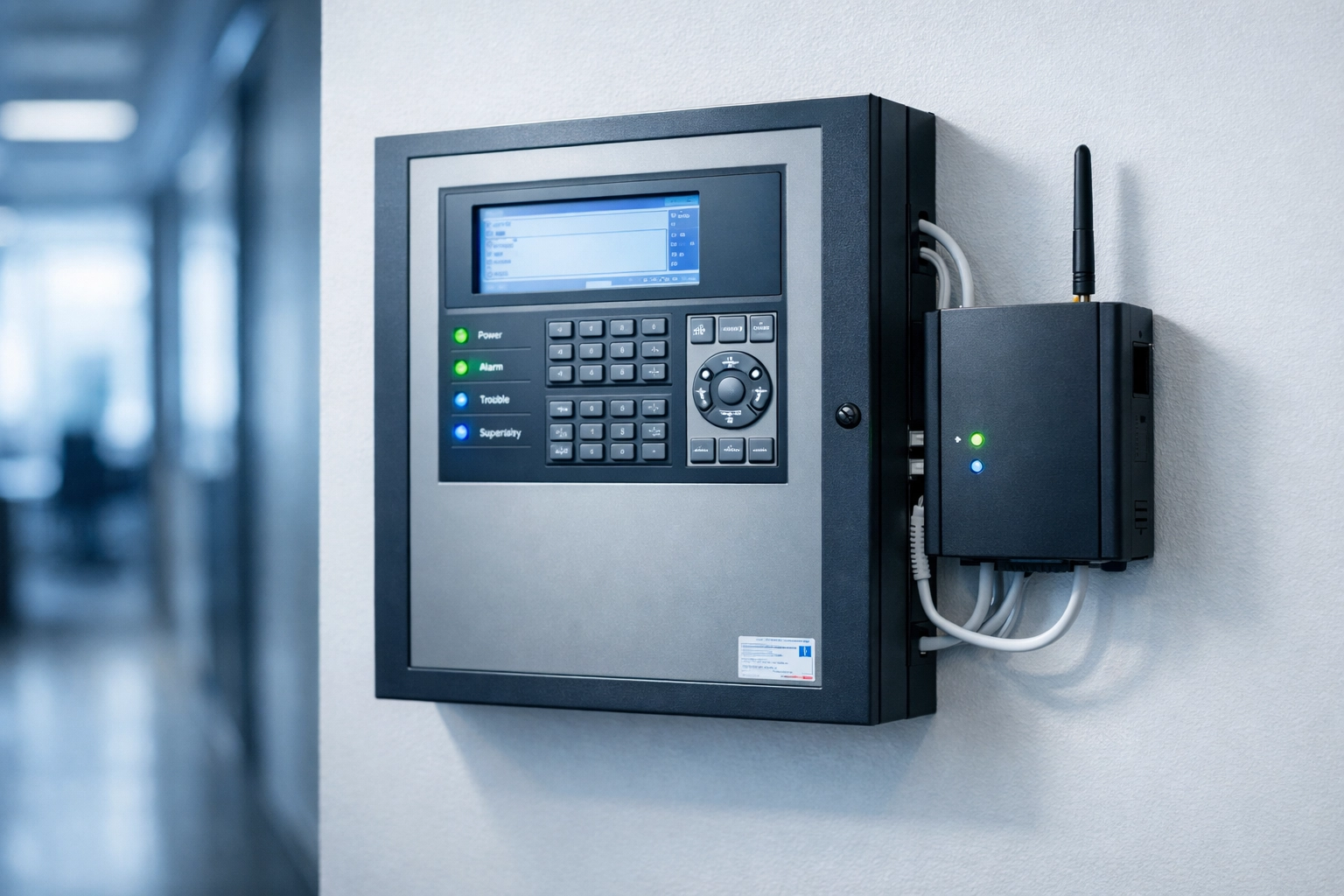
Modern fire alarm control panel with cellular backup for NFPA 72 compliance

Critical Use Cases: Where POTS Replacement Delivers Maximum Value

Commercial Real Estate and Property Management

If you manage office buildings, retail centers, or residential properties, you're likely paying for dozens of POTS lines across elevators, fire alarms, and access control systems. POTS replacement delivers immediate cost savings at scale while simplifying management across your entire portfolio.

Healthcare Facilities

Hospitals, clinics, and senior living facilities rely on life-safety systems that cannot fail. Modern POTS replacement solutions offer the reliability healthcare requires with better monitoring, faster issue resolution, and compliance documentation that makes audits easier.

Retail and Hospitality

From point-of-sale backup lines to fire monitoring, retail and hospitality businesses use POTS lines extensively. Replacing these systems delivers cost savings while enabling advanced features like centralized management and remote troubleshooting across multiple locations.

Manufacturing and Warehousing

Large facilities often have POTS lines scattered across buildings for security, fire suppression monitoring, and emergency communications. Consolidating and modernizing these systems reduces costs while improving visibility and control.

Making the Switch: What to Expect

The POTS migration process is designed for simplicity and business continuity:

  1. Assessment: We audit your current POTS lines, usage patterns, and compliance requirements
  2. Solution Design: We recommend the optimal replacement technology for each use case
  3. Migration Planning: We schedule installations to minimize disruption and maintain 24/7 system availability
  4. Installation and Testing: Our certified technicians handle all installation, testing, and compliance verification
  5. Ongoing Management: We provide continuous monitoring, support, and optimization

Most businesses complete their POTS replacement within 30-60 days from initial assessment to final cutover. The ROI typically appears in the first month through immediate cost savings.

Frequently Asked Questions About POTS Replacement

Q: Will POTS replacement affect my fire alarm or elevator inspections?

A: No. Modern POTS replacement solutions are specifically certified for NFPA 72 compliance and building code requirements. In many cases, they actually improve inspection results through better monitoring and testing capabilities.

Q: How much can I really save by replacing POTS lines?

A: Most businesses see 30% to 70% cost reductions, with some achieving savings of 75% or more. Actual savings depend on your current POTS pricing, number of lines, and chosen replacement solution. Contact us for a free cost analysis.

Q: What happens if my internet goes down, will my fire alarm or elevator phone still work?

A: Yes. Modern POTS replacement solutions include cellular backup and redundancy options specifically to ensure life-safety systems remain operational even during network outages.

Q: Is POTS replacement complicated? Will it disrupt my business?

A: POTS replacement is a fully managed process. We handle everything from assessment through installation and testing. Most businesses experience zero downtime for critical systems during migration.

Q: Can I keep some POTS lines and replace others gradually?

A: Absolutely. We can design phased migration plans that prioritize high-cost or high-risk lines while keeping others operational during transition. This approach often makes sense for large facilities with dozens of lines.

Take Action Before Copper Sunset Forces Your Hand

The copper sunset 2026 timeline means one thing: POTS replacement is no longer optional: it's strategic infrastructure planning. Waiting until carriers force discontinuation means losing control over timing, costs, and solution selection. If you’re using this project to kick off broader modernization, start with a practical roadmap like Digital Transformation Simplified and align stakeholders with The Premier Advantage: Strategic Technology Consulting.

The businesses winning right now are those treating POTS line replacement as a proactive ROI opportunity rather than a reactive emergency. They're locking in lower costs, improving reliability, ensuring compliance, and positioning their infrastructure for long-term success.

Premier Business specializes in comprehensive POTS replacement solutions that deliver immediate cost savings while maintaining the reliability and compliance your critical systems demand. Our managed approach means zero headaches, full compliance, and substantial ROI from day one.

Ready to see how much you could save by modernizing your legacy POTS lines? Contact Premier Business today for a free assessment and customized migration plan. Let's turn copper sunset from a threat into your next big ROI win.

Are You Wasting $500/Month on Hidden POTS Lines? The Multi-Location Audit That Found 127 Forgotten Analog Lines

premierbusiness · February 19, 2026 ·

When a national retail chain reached out to Premier Business Team for a routine telecom review, they expected to find minor inefficiencies. What we uncovered instead was a $18,000-per-month drain on their budget, 127 forgotten analog POTS lines scattered across 84 locations, many of which hadn't been touched in years.

If your organization operates multiple sites, you're likely sitting on a similar pile of wasted spend. Here's what we found, why it happens, and how to stop the bleeding before copper sunset deadlines make the problem worse.

The $18,000 Problem Nobody Knew Existed

The client, a fast-growing franchise operator in the automotive sector, had grown from 12 locations to 84 over eight years through acquisitions and rapid expansion. Each new site came with its own telecom setup, and nobody had ever consolidated or audited the full network.

Our vendor-neutral audit revealed:

  • 127 active POTS lines still being billed monthly
  • 63 lines connected to nothing (literally unplugged or serving decommissioned equipment)
  • 41 lines tied to outdated fax machines that hadn't sent a document in over two years
  • 23 lines designated as "backup" for alarm systems that had since been upgraded to cellular

Average cost per line? $142/month. Total monthly waste? Over $18,000.

This wasn't malicious. It was organizational drift. When locations changed hands, upgraded systems, or switched vendors, the old POTS lines just… stayed. Billing kept rolling. Nobody noticed.

Business owner reviewing multiple hidden POTS line invoices and telecom billing statements

Why "Ghost" POTS Lines Are More Common Than You Think

If you're reading this and thinking, "That would never happen to us," consider this: POTS replacement is one of the least-visible line items on a multi-location telecom invoice. Unless you're conducting regular infrastructure audits, here's why forgotten lines accumulate:

1. Acquisition Chaos

When you acquire a new location, you inherit their telecom contracts. The previous owner's alarm line, backup elevator phone, or legacy fax service doesn't announce itself, it just keeps getting paid.

2. Vendor Fragmentation

Multi-location businesses often have a patchwork of providers: AT&T here, Lumen there, Verizon somewhere else. Each sends separate invoices. Nobody's cross-checking for redundancies.

3. Upgrade Oversights

You modernize your phone system to VoIP. Great! But did anyone cancel the old analog lines that used to power your fire panel, entry buzzer, or credit card terminal? Probably not.

4. Copper Sunset Price Hikes

As carriers phase out POTS infrastructure, they're actively raising prices on remaining analog services, sometimes by 50–200%, hoping customers migrate voluntarily. Many businesses don't even notice the increase buried in their bill.

5. The "Just in Case" Mentality

"We might need that line someday." Famous last words. That elevator phone backup line from 2014? Still there. Still costing $95/month. Still unused.

The Real Cost of Doing Nothing

Let's break down what $18,000/month actually means over time:

  • 1 year: $216,000 wasted
  • 3 years: $648,000 wasted
  • 5 years: $1,080,000 wasted

For our client, the waste had been going on for at least four years. That's over $860,000 down the drain, money that could have funded new locations, upgraded infrastructure, or boosted profitability.

And with AT&T planning to fully discontinue most POTS services by 2029, the clock is ticking. If you wait until the last minute, you'll be scrambling to replace critical systems under deadline pressure, often at higher costs and with fewer options.

Old analog copper POTS equipment compared to modern VoIP phone system infrastructure

How the Audit Uncovered the Waste

Premier Business Team's vendor-neutral telecom audit follows a systematic process designed to surface exactly these kinds of inefficiencies. Here's how it worked for the retail chain:

Step 1: Invoice Consolidation

We collected 18 months of telecom invoices from all locations and vendors. This alone revealed billing inconsistencies and duplicate charges.

Step 2: Physical Site Surveys

Our team visited each location to physically trace every line. Where did it terminate? What device was it serving? Was it active?

Step 3: Cross-Reference with Current Systems

We compared the physical infrastructure to the client's current tech stack. Did they still use fax machines? Had alarm systems been upgraded? Were elevator phones compliant with current codes?

Step 4: Cost-Benefit Analysis

For each line, we calculated the monthly cost versus its actual business value. Many "backup" lines were costing more annually than replacing the entire system with a modern alternative.

Step 5: Vendor-Neutral Recommendations

Unlike single-vendor consultants, we presented multiple POTS replacement solutions, VoIP, POTS-in-a-box, LTE transponders, and fiber-based alternatives, based solely on what fit the client's needs and budget.

The Solution: Consolidation, Modernization, and Real Savings

After the audit, we implemented a phased replacement strategy:

  • Eliminated 63 disconnected lines immediately (savings: $8,946/month)
  • Migrated 41 fax lines to cloud-based eFax services (savings: $4,387/month)
  • Upgraded 23 alarm/elevator lines to LTE or fiber-based POTS alternatives (savings: $2,714/month)

Total monthly savings: $16,047

The client kept the necessary services (elevator phones, fire alarms, etc.) fully compliant and operational, but cut their POTS-related spend by 89%. Over five years, that's $962,820 back in their pocket.

Even better? They now have a centralized telecom dashboard that tracks every line across every location in real time. No more surprises.

Telecom consultant conducting POTS line audit with digital checklist in equipment room

Your Next Steps: Don't Wait for Copper Sunset

If your organization operates multiple locations, retail, healthcare, property management, automotive, hospitality, you almost certainly have hidden POTS waste. Here's what to do:

  1. Request a full telecom audit. Get every invoice from every vendor for the last 12–18 months.
  2. Physically verify every line. Don't trust the invoice. Walk the sites.
  3. Identify replacement candidates. Which lines can be eliminated? Which need modern alternatives?
  4. Act before deadlines hit. Copper sunset is coming. Proactive migration saves money. Reactive scrambling costs it.

Premier Business Team specializes in vendor-neutral telecom consulting for multi-location businesses. We don't sell one solution, we find the right mix of providers and technologies to maximize your cost savings and operational efficiency.

Frequently Asked Questions

What is a POTS line?
POTS (Plain Old Telephone Service) is a traditional analog phone line running over copper infrastructure. These lines are being phased out by major carriers as they transition to fiber and IP-based networks.

Why are POTS lines so expensive now?
As carriers retire copper infrastructure, maintenance costs rise while customer bases shrink. To push migration, many providers have increased POTS pricing by 50–200% in recent years.

Can I just cancel all my POTS lines?
Not always. Some lines serve critical safety systems like elevators, fire alarms, or entry buzzers that require specific compliance certifications. You'll need compliant alternatives in place first.

What are the best POTS replacement options for 2026?
Modern alternatives include VoIP systems, POTS-in-a-box devices, LTE transponders, and fiber-based analog emulation. The best choice depends on your use case (elevator, alarm, fax, etc.) and existing infrastructure.

How long does a multi-location telecom audit take?
For most organizations, a comprehensive audit takes 4–8 weeks, depending on the number of locations and invoice complexity. The ROI typically shows up in the first month of post-audit savings.

Will switching away from POTS affect my elevator or fire alarm compliance?
No: if done correctly. Modern POTS replacement solutions are designed to meet NFPA 72 and ASME A17.1 compliance standards. Premier Business Team ensures all replacements maintain full regulatory compliance.

Stop the Waste. Start Saving Today.

You wouldn't let $18,000 walk out the door every month in cash. So why let it drain away on unused phone lines?

If you operate multiple locations and haven't audited your telecom infrastructure in the last 12 months, you're almost certainly overpaying. The good news? It's fixable: and the savings can be dramatic.

Ready to find your hidden POTS waste? Premier Business Team offers vendor-neutral telecom audits for multi-location businesses nationwide. We'll identify every line, calculate your true costs, and build a modernization roadmap that saves you money while keeping your systems compliant and operational.

Call us today at 360-946-2626 or visit premierbusinessteam.com to schedule your free consultation. Let's uncover those ghost lines before copper sunset turns them into an even bigger problem.

Cybersecurity Risk Management: A Strategic Guide to Identifying, Protecting, and Recovering Your Business Data

premierbusiness · February 18, 2026 ·

Here's the uncomfortable truth: cybersecurity isn't something you can buy once and forget about. It's not a product, it's a process. And in 2026, with ransomware attacks costing businesses an average of $4.35 million per breach, the process better be airtight.

The good news? You don't need to become a cybersecurity expert overnight. You just need a strategic framework and a partner who knows how to navigate the 330+ security providers flooding the market with promises, buzzwords, and conflicting solutions.

That's where Premier Business Team comes in. We don't sell you the most expensive firewall or the flashiest endpoint protection platform. We help you build a risk management strategy tailored to your actual threats, your actual budget, and your actual business operations, using the proven NIST Cybersecurity Framework as our foundation.

What Is the NIST Cybersecurity Framework?

The NIST Cybersecurity Framework is a set of voluntary guidelines developed by the National Institute of Standards and Technology to help organizations manage and reduce cybersecurity risk. It's built around five core functions: Identify, Protect, Detect, Respond, and Recover.

Think of it as the blueprint for building a resilient business, one that doesn't just survive a cyberattack, but bounces back quickly and learns from it.

Unlike compliance checklists that focus on checking boxes, NIST is outcome-driven. It forces you to ask the right questions: What are we protecting? Who has access? How quickly can we detect an intrusion? What happens if our backups fail?

These aren't hypothetical questions. They're the difference between a minor security incident and a company-killing catastrophe.

Cybersecurity operations center monitoring network threats and data security dashboards

The Five Pillars of Cybersecurity Risk Management

1. Identify: Know What You're Protecting Before You Protect It

You can't defend what you don't understand. The Identify phase is all about taking inventory of your digital ecosystem, every application, every database, every connected device, and every third-party integration.

This includes:

  • Hardware and network infrastructure (routers, switches, servers, endpoints)
  • Critical business applications and data repositories (CRM, ERP, financial systems)
  • Third-party systems and APIs (cloud services, SaaS platforms, vendor portals)
  • People and processes (who has admin access? What permissions do employees have?)

Once you've mapped your digital landscape, you need to classify assets based on business criticality. Not all data is created equal. Your customer database deserves Fort Knox-level protection. Your internal meme archive? Not so much.

This classification becomes the foundation for every decision you make downstream, from budget allocation to incident response prioritization.

2. Protect: Build Your Digital Perimeter (Without Slowing Down Your Business)

The Protect function is where theory meets execution. This is where you establish access controls, deploy data encryption, configure firewalls, and, most importantly, train your employees not to click on phishing emails.

Here's what protection looks like in practice:

  • Access control and identity management: Implement multi-factor authentication (MFA), role-based access control (RBAC), and principle of least privilege. If someone doesn't need access to payroll data, they shouldn't have it.
  • Data security: Encrypt sensitive data both in transit and at rest. Use secure file-sharing platforms. Establish clear data retention and disposal policies.
  • Security awareness training: Your employees are either your strongest defense or your biggest vulnerability. Regular training turns them into human firewalls. (And yes, this includes teaching them how to spot deepfake scams in 2026.)
  • Endpoint and network protection: Deploy firewalls, intrusion prevention systems, and endpoint detection and response (EDR) tools that actually work together instead of creating alert fatigue.

At Premier Business Team, we don't just recommend the most expensive solution or the one with the slickest sales pitch. We represent 330+ pre-vetted security providers, which means we find the protection strategy that fits your business: not the one that pays us the highest commission. Learn more about our approach in The Premier Advantage.

Multi-factor authentication protecting business data with layered security controls

3. Detect: Catch the Bad Guys Before They Settle In

Even with Fort Knox-level protection, threats will slip through. The question isn't if an attacker will attempt to breach your network: it's when. And when they do, speed matters.

The Detect function focuses on continuous monitoring and anomaly detection:

  • Real-time monitoring: Deploy Security Information and Event Management (SIEM) tools that aggregate logs, analyze traffic patterns, and flag suspicious activity before it escalates.
  • Threat intelligence: Stay informed about emerging threats, zero-day vulnerabilities, and industry-specific attack vectors. Context matters.
  • Behavioral analytics: Modern detection systems use AI and machine learning to identify deviations from normal behavior: like a user suddenly downloading 50GB of data at 3 a.m.

The faster you detect an intrusion, the less damage an attacker can do. Businesses that detect breaches within minutes contain them. Those that take weeks? They make headlines for all the wrong reasons.

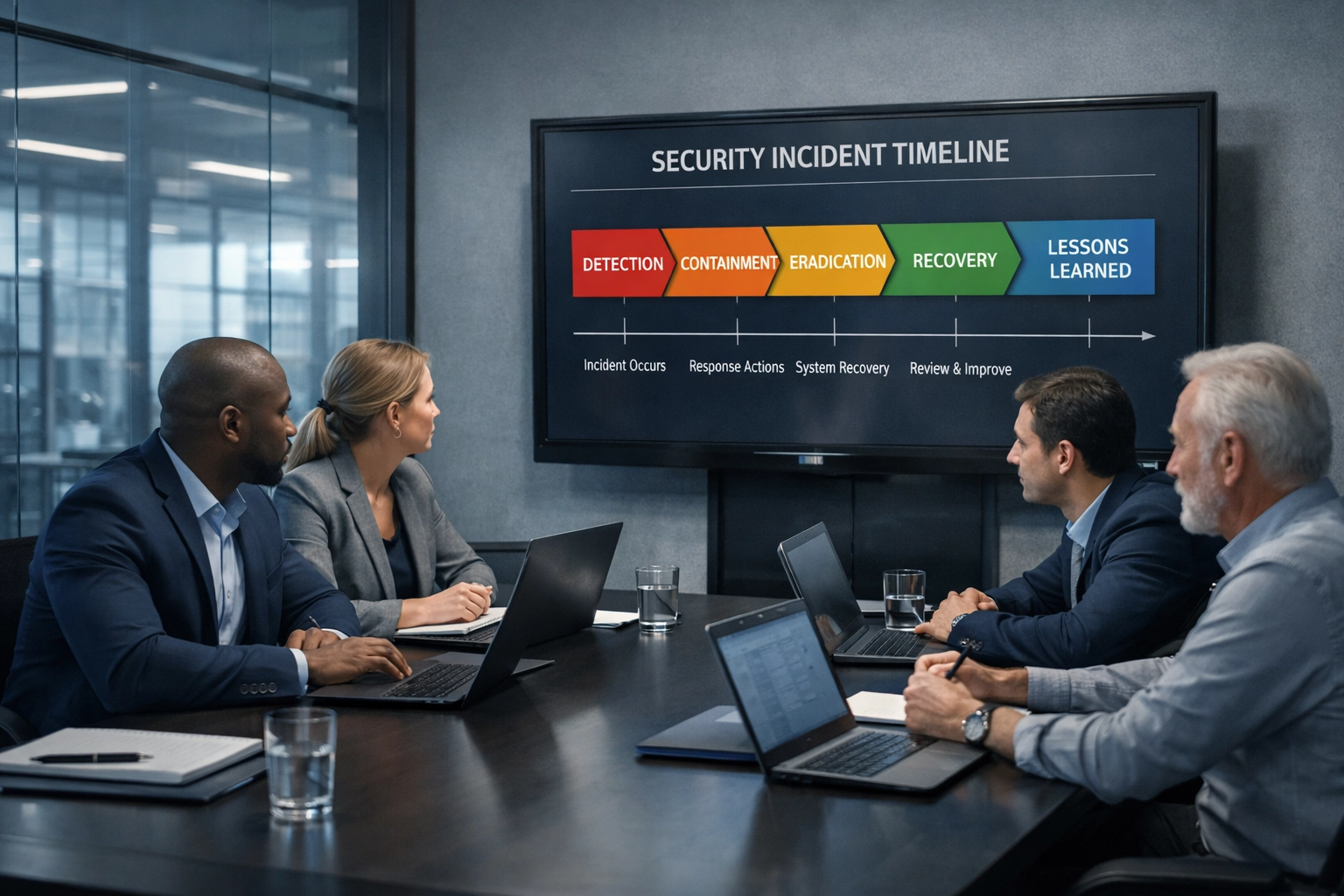
4. Respond: What Happens When the Alarm Goes Off

Detecting a threat is only half the battle. The Respond function is your game plan for when things go sideways.

A solid incident response plan includes:

  • Preparation: Pre-assign roles and responsibilities. Who leads the response? Who communicates with customers? Who contacts law enforcement?
  • Containment: Isolate affected systems immediately to prevent lateral movement across your network.
  • Eradication: Remove the threat from your environment: whether it's malware, compromised credentials, or an insider threat.
  • Analysis and lessons learned: Conduct a post-incident review. What went wrong? How did the attacker get in? What controls failed? Update your defenses accordingly.

Response isn't just about damage control: it's about minimizing downtime and preserving customer trust. A well-executed response can turn a potential PR disaster into a case study in resilience.

Real-time network threat detection system monitoring for cybersecurity anomalies

5. Recover: Getting Back to Business as Usual

The Recover function is where business continuity meets cybersecurity. It's not enough to remove the threat: you need to restore operations quickly and ensure it doesn't happen again.

Key recovery strategies include:

  • Backup and disaster recovery: Implement the 3-2-1 backup rule (3 copies of data, 2 different media types, 1 offsite). Test your backups regularly. A backup you've never restored is just wishful thinking.
  • Resilience planning: Identify critical business processes and establish recovery time objectives (RTO) and recovery point objectives (RPO) for each.
  • Communication protocols: Keep employees, customers, and stakeholders informed throughout the recovery process. Transparency builds trust.

Recovery isn't a one-time event. It's an ongoing commitment to learning, adapting, and improving your defenses based on real-world experience.

The Premier Business Team Approach: Strategic Risk Management, Not Security Theater

Here's what makes our cybersecurity consulting different:

We're vendor-neutral. We don't have quotas to hit or kickbacks to collect. Our only incentive is finding the right solution for your business: whether that's a best-in-class enterprise platform or a cost-effective SMB solution.

We follow a proven 5-step process:

  1. Design: We assess your current security posture, map your risk landscape, and identify gaps.
  2. Proposal: We present tailored recommendations with transparent pricing and expected outcomes.
  3. Selection: We help you evaluate options and choose solutions that align with your business goals.
  4. Implementation: We coordinate deployment, minimize disruption, and ensure everything works as promised.
  5. Support: We provide ongoing monitoring, optimization, and strategic guidance as threats evolve.

We integrate cybersecurity into your broader digital transformation strategy. Security isn't a silo: it's a foundational element of network agility, cloud adoption, and customer experience.

And perhaps most importantly, we translate technical jargon into business language. You don't need to understand the difference between a zero-trust architecture and a SASE framework: you just need to know your business is protected.

Business team developing cybersecurity incident response and risk management strategy

How Do I Handle Cybersecurity Risks?

To handle cybersecurity risks effectively, follow a structured framework: identify your critical assets, protect them with layered defenses, continuously monitor for threats, respond quickly when incidents occur, and maintain recovery plans to ensure business continuity.

The key is treating cybersecurity as a strategic business priority: not an IT problem. That means:

  • Involving leadership in risk decisions
  • Aligning security investments with business objectives
  • Measuring effectiveness with clear metrics
  • Adapting as threats and business needs evolve

At Premier Business Team, we don't just hand you a security checklist and walk away. We become your strategic advisor: helping you navigate vendor complexity, make informed decisions, and build a resilient organization from the ground up.

Stop Guessing. Start Protecting.

Cybersecurity risk management doesn't have to be overwhelming. With the right framework, the right partner, and a vendor-neutral approach, you can build a defense strategy that protects your business without breaking the bank or grinding operations to a halt.

Ready to stop playing cybersecurity roulette?

Schedule a free Cybersecurity Strategy Session with Premier Business Team. We'll assess your current posture, identify gaps, and provide a roadmap for reducing risk without the sales pitch.

👉 Contact us today and let's build a cybersecurity strategy that actually works.

Digital Transformation Simplified: The Premier Roadmap to Future-Proofing Your Business

premierbusiness · February 18, 2026 ·

Digital transformation. Two words that send shivers down the spine of every business owner who's heard one too many buzzword-laden sales pitches.

Here's the truth: Digital transformation isn't about ripping out your entire tech stack and replacing it with the shiniest new toys. It's about strategically evolving your infrastructure, processes, and customer experiences to stay competitive in a world where Amazon, AI, and cloud-native startups are rewriting the rules daily.

At Premier Business Team, we've guided hundreds of organizations through this journey: without the fluff, the fear-mongering, or the vendor lock-in. This is your no-nonsense roadmap to future-proofing your business, Premier-style.

Connected devices showing digital transformation infrastructure with laptop, tablet, and smartphone

What Digital Transformation Actually Means (Hint: It's Not Just "Going Cloud")

Digital transformation is the strategic integration of technology across your entire business to fundamentally improve how you operate and deliver value to customers. It's not a single project: it's an ongoing evolution that touches everything from your network infrastructure to your customer service strategy.

The problem? Most businesses approach transformation backwards. They chase technology trends instead of solving real business problems. They buy software before building the network foundation to support it. They implement security as an afterthought instead of baking it into every layer.

A proper digital transformation roadmap aligns technology investments with your actual business goals, whether that's reducing operational costs, improving customer satisfaction, enabling remote work, or scaling into new markets.

Let's break down the five critical pillars that form the foundation of any successful transformation strategy.

The Five Pillars of Digital Transformation (That Actually Matter)

1. Network Agility: The Foundation for Everything Else

Your network is the circulatory system of your digital infrastructure. If it's clogged, slow, or unreliable, nothing else works properly: not your cloud apps, not your IoT devices, not your AI initiatives, not your remote workforce.

Modern businesses need hybrid network strategies that combine:

  • High-speed fiber for bandwidth-intensive applications
  • SD-WAN to intelligently route traffic and prioritize critical services
  • Redundant connections to eliminate single points of failure
  • Low-latency connectivity for real-time applications

We wrote an entire guide on how SD-WAN revolutionizes network performance, but here's the executive summary: SD-WAN allows you to leverage multiple connection types (fiber, broadband, 5G) while intelligently routing traffic based on application priority and network conditions. It's the difference between your Zoom calls pixelating during critical client meetings and your team collaborating seamlessly from anywhere.

2. Engineered Customer Experiences: Turning Service Into a Competitive Weapon

Customer expectations have been permanently reset. They expect omnichannel engagement (chat, voice, email, text, social), instant responses, and personalized experiences. Anything less, and they're gone.

Cloud Contact Center (CCaaS) solutions transform customer interactions by:

  • Routing customers to the right agent with the right expertise
  • Providing agents with complete customer history across all channels
  • Integrating AI for sentiment analysis and suggested responses
  • Enabling seamless work-from-anywhere support teams
  • Capturing analytics that reveal patterns in customer behavior

Companies that nail customer experience grow revenues 4-8% faster than their competitors. The technology to deliver that experience is no longer optional: it's table stakes.

Cloud contact center team providing omnichannel customer service across multiple devices

3. Optimized Connectivity: Getting Users Closer to Their Applications

Here's a problem most businesses don't realize they have: Every millisecond of latency costs you productivity and revenue. When employees in your Seattle office access cloud applications hosted in Virginia through a traditional hub-and-spoke network architecture, they're taking the scenic route.

Modern connectivity strategies shorten the distance between users and their cloud resources through:

  • Direct cloud on-ramps that bypass unnecessary network hops
  • Strategic SD-WAN implementations that route traffic intelligently
  • Regional Points of Presence (PoPs) for global organizations
  • Content Delivery Networks (CDNs) for customer-facing applications

The result? Faster application performance, reduced frustration, and employees who can actually get their work done without staring at loading screens.

4. SaaS & Cloud Ecosystems: Maximizing ROI While Reducing Complexity

Most businesses are drowning in SaaS sprawl: dozens of disconnected applications that don't talk to each other, redundant tools performing similar functions, and IT teams spending more time managing integrations than driving strategic value.

Optimizing your cloud ecosystem means:

  • Auditing existing SaaS subscriptions to eliminate redundancy
  • Selecting integrated platforms over point solutions when possible
  • Implementing Single Sign-On (SSO) to improve security and user experience
  • Establishing governance policies for SaaS procurement
  • Leveraging APIs to connect critical business systems

We regularly help clients discover they're paying for three different video conferencing platforms, two CRM systems, and four project management tools. Consolidating and integrating your cloud stack doesn't just reduce costs: it creates a unified data environment that enables better decision-making.

5. Real-Time Security: Protecting Your Business Without Slowing It Down

Traditional security models: the "castle and moat" approach where you protect the perimeter: are dead. When your employees work from home, your data lives in the cloud, and your applications run on third-party infrastructure, the perimeter no longer exists.

Modern security is built on two principles:

  1. Zero Trust: Verify every user, device, and application before granting access, regardless of location
  2. SASE (Secure Access Service Edge): Converge networking and security into a unified cloud-delivered service

We've written extensively about cybersecurity strategies that actually work, but here's what matters most: Security must be integrated directly into your transformation strategy, not bolted on afterward.

Cloud-based security controls, endpoint detection and response (EDR), and managed detection and response (MDR) services provide enterprise-grade protection without requiring a massive in-house security team.

Network operations center monitoring cybersecurity dashboards and network security systems

The Premier Edge: Why Vendor-Neutral Guidance Changes Everything

Here's what makes Premier Business Team different from every other "technology advisor" you've talked to: We don't sell hardware or software. We sell clarity, strategy, and access to the nation's most comprehensive carrier ecosystem.

Our 330+ Pre-Vetted Carriers Mean You Get Options (Not Sales Pitches)

When you work with a single vendor, you get their solution: whether it fits your needs or not. When you work with Premier, you get access to hundreds of providers, technologies, and price points. We evaluate your requirements, negotiate on your behalf, and present you with options that actually make sense for your business.

Our 5-Step Process Eliminates the Guesswork

Digital transformation fails when it's treated as a purely technical exercise. It succeeds when it's approached as a strategic business initiative with clear objectives, measurable outcomes, and proper change management.

Our proven methodology includes:

  1. Design: We assess your current state, identify gaps, and create a comprehensive transformation roadmap aligned with your business goals
  2. Proposal: We leverage our carrier relationships to deliver competitive proposals from multiple vendors
  3. Selection: We guide you through evaluation criteria to select the best-fit solutions
  4. Implementation: We project-manage deployment to ensure on-time, on-budget execution
  5. Support: We provide ongoing monitoring, optimization, and strategic guidance as your needs evolve

Want to see how this process works in practice? Check out our comprehensive guide to The Premier Advantage and our strategic technology consulting approach.

Our 500+ Technical Certifications Mean We Actually Know What We're Talking About

Digital transformation isn't one-size-fits-all. Healthcare organizations face different challenges than financial services firms. Manufacturing companies have different requirements than professional services businesses.

Our team's deep technical expertise across networking, cloud, security, and unified communications means we understand the nuances of your industry and can architect solutions that address your specific pain points.

Business strategy planning session for digital transformation with security and analytics documents

Digital Transformation FAQ: Quick Answers to Common Questions

Q: How long does digital transformation take?
A: It's an ongoing journey, not a destination. Initial transformations typically occur in 6-18 month phases, but continuous optimization should be part of your operational DNA.

Q: What's the biggest mistake businesses make during digital transformation?
A: Starting with technology instead of business outcomes. Technology should solve problems, not create new ones.

Q: Do we need to replace everything at once?
A: Absolutely not. Phased approaches reduce risk and allow you to learn and adapt along the way. Strategic roadmaps prioritize initiatives based on impact and feasibility.

Q: How do we know if our digital transformation is successful?
A: Define success metrics upfront: reduced operational costs, improved customer satisfaction scores, faster time-to-market, increased employee productivity. If you can't measure it, you can't manage it.

Q: What's the ROI of digital transformation?
A: McKinsey research shows that companies executing successful digital transformations can achieve 20-30% improvements in operational efficiency and 20% revenue growth. But ROI varies dramatically based on your industry, maturity level, and execution quality.

Ready to Future-Proof Your Business?

Digital transformation doesn't have to be overwhelming, expensive, or risky. With the right roadmap, vendor-neutral guidance, and strategic execution, you can evolve your infrastructure to support whatever the market throws at you next: whether that's AI workloads, hybrid workforce demands, or the next disruptive technology we haven't even heard of yet.

Premier Business Team has helped hundreds of organizations navigate their digital transformation journeys. We bring carrier relationships, technical expertise, and strategic thinking to every engagement: without the vendor bias that plagues traditional consultants.

Let's build your roadmap together. Contact Premier Business Team today for a complimentary technology assessment and discover how vendor-neutral guidance can transform your approach to digital infrastructure.

📞 Call us or visit our website to schedule your strategic consultation. Your competitors are already transforming( don't get left behind.)

  • « Go to Previous Page
  • Page 1
  • Interim pages omitted …
  • Page 13
  • Page 14
  • Page 15
  • Page 16
  • Page 17
  • Interim pages omitted …
  • Page 78
  • Go to Next Page »

Get a no obligation quote for your business. Learn More

Proud Chamber Member

Bellingham Chamber Badge

Premier Business Team

Copyright © 2026 · Premier Business Team 2219 Rimland Dr. Suite 301 Bellingham, WA 98226 - 360-946-2626

  • Home
  • Business Internet
  • Business Phone
  • Blog
  • About Us
  • Contact Us
  • Business Quote
  • Engineering
  • Call: 360-946-2626